Political Censorship and Creative Resistance: Genre, Allegory, and Critique in Contemporary Chinese-Language Cinema
Genre, Allegory, and Critique in Contemporary Chinese-Language Cinema • How Political Constraint Generates Aesthetic Sophistication
The Productive Paradox: Constraint and Aesthetic Sophistication
For decades the most widespread understanding of censorship in China was that it was a crude, blunt instrument of state control over information: a means of repressing dissent and stamping out debate. That perception is not entirely wrong, but it does hide much of the truth. As media scholar Thomas M. Chen (2022) argues in Made in Censorship, the state's regulation of cinema functions not merely as a repressive force, but as a "productive" one, generating structural pressures that compel filmmakers to develop innovative formal and narrative strategies to speak critically within, around, and against the limits of what can be publicly represented.
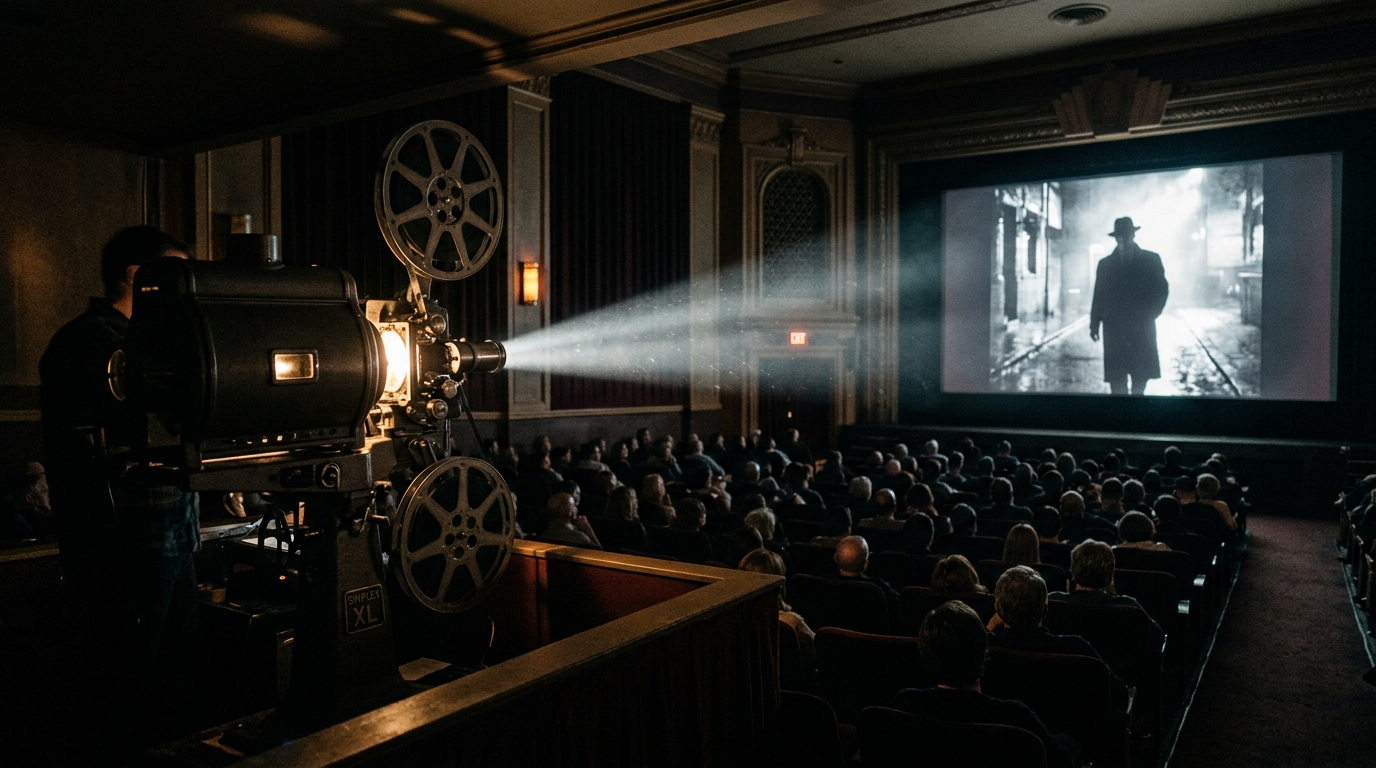
Since the centralization of cultural authority under Xi Jinping, the Chinese Communist Party (CCP) has tightened its grip on the film industry (Hale, 2021; Rosen, 2021). Yet, faced with these constraints, filmmakers have developed what might be called "navigational strategies"—formal and generic choices that allow them to stage politically pointed critiques while remaining, formally at least, within the bounds of censorship tolerance.
As demonstrated by films such as Jia Zhangke's A Touch of Sin (2013), Diao Yinan's Black Coal, Thin Ice (2014), and Zhang Yimou's One Second (2020), the deployment of wuxia, noir, and historical melodrama conventions allows for an implicit critique of corruption and social decline (Ashok, 2014; Stone, 2012).
The Censorship Mechanism: Gatekeeping by a Thousand Cuts
Analyzing the methods employed by filmmakers requires a basic understanding of the censorship system itself. The CCP's involvement with film is as old as the People's Republic itself, but censorship has become considerably more robust and institutionalized under Xi Jinping (Rosen, 2021). After securing power and cracking down on perceived corruption, the CCP brought the film industry under direct ideological control due to cinema's immense mass appeal and emotional potency.
Film under the current system must receive approval at multiple distinct stages. The China Film Administration (CFA), led directly by the Central Propaganda Department, controls licensing, production permits, and domestic financing:
- Stage 1: Script Pre-Approval & Synopsis Vetting: Before pre-production can commence, a complete treatment and screenplay must be submitted to the CFA. Any overt political critique, sympathetic portrayal of dissidents, or depiction of high-level corruption is flagged or rejected at the written stage.
- Stage 2: Production Supervision & Provincial Guidance: Regional propaganda bureaus maintain operational oversight over filming locations, requiring permits for sensitive urban or rural backdrops.
- Stage 3: Review Board Rough-Cut Screening: The completed work is submitted to a panel of censors who evaluate audio, visual pacing, and thematic alignment against expansive, unwritten "red lines."
- Stage 4: Issuance of the Dragon Seal (Longbiao): The coveted animated green seal granting theatrical distribution rights, broadcast clearance, and permission for international festival submission.
Censors operate not from a public, transparent legal code, but from a collection of unspoken "red lines" and fluctuating sensitivity thresholds (Hale, 2021). Categories of prohibited subject matter are expansive, covering negative depictions of government officials, scenes of organized social unrest, religious or ethnic tensions, and historical events the Party prefers to strictly curate—most notably the Cultural Revolution (1966–1976), the Great Leap Forward, and the 1989 Tiananmen Square protests.
Gatekeeping takes place by a thousand cuts: filmmakers must try to read their own censor's mind, constantly guessing at the trigger points while trying to maintain the aesthetic integrity and emotional resonance of their vision. This institutional ambiguity induces an insidious form of pre-emptive self-censorship, yet simultaneously catalyzes sophisticated forms of narrative misdirection.
Genre as Camouflage: The Aesthetic of Indirection
The censorship system is "productive" in that it bends expression rather than extinguishes it. The systemic corruption filmmakers cannot directly depict and the state violence they cannot explicitly show are staged through other aesthetic means—from genre conventions to visual metaphor, and through the rhetorical deployment of absence, ellipsis, and silence. The censorship regime thus inadvertently cultivates an entire aesthetic of indirection and allegory (Chen, 2022).
One of the most potent strategies is weaponizing genre. Genre works like political immunity: a noir detective procedural or a wuxia martial revenge tale can be plausibly presented to the review board as "mere commercial entertainment." A detective noir set in a crumbling post-industrial cityscape draws visceral attention to moral rot and institutional incompetence, which can be excused because such tropes are historically inherent to the noir genre itself. Wuxia, similarly, has for centuries served as an indigenous cultural vessel for narratives of popular resistance to bureaucratic tyranny and feudal oppression. Genre functions as a Trojan horse, smuggling subversive critique past the censor by coding it in the familiar vernacular of mass entertainment.
Select a cinematic strategy below to examine how filmmakers camouflage critique from state censors:
| Genre Framework | Surface Coding (Censor Approval) | Latent Subtext (Smuggled Critique) | Censorship Vulnerability |
|---|---|---|---|
| Wuxia (Martial Knight) | Stylized martial arts action, honor duels, period folklore. | Underclass moral rebellion against corrupt local oligarchs and predatory economic displacement. | Moderate: Permits can be withheld if violence too closely mirrors ongoing viral labor protests. |
| Neo-Noir (Crime Thriller) | Police hunting a psychotic serial killer across winter rustbelt cities. | Pervasive spiritual decay, institutional breakdown, and the atomization of working-class solidarity. | Low-to-Moderate: Nihilism can be dismissed as atmospheric convention inherent to the noir tradition. |
| Melodrama & Meta-Cinema | Tearful personal family sacrifice and nostalgic communal love for 35mm celluloid film. | Collective trauma of political persecution, ideological labor camps, and forced historical amnesia. | High: Encounters absolute Party sensitivity thresholds surrounding memory management. |
Case Study 1: The Wuxia Allegory in A Touch of Sin (2013)
Jia Zhangke's A Touch of Sin (2013) deploys this navigational strategy with extraordinary clarity and theoretical precision (Ashok, 2014; Berry, Lu, & Rofel, 2014). Directly inspired by King Hu's 1971 classic A Touch of Zen, the film is structured as an anthology of four loosely interconnected vignettes based on real-life, sensational incidents of violence reported in Chinese newspapers and microblogs:
1. Dahai (Shanxi): An alienated coal miner who petitions against the corrupt village chief who privatized the collective mine to purchase private jets and Maserati sports cars. Ignored by municipal authorities and beaten by company thugs, Dahai takes up a hunting rifle to execute the village elite.
2. Zhou San (Chongqing): A disaffected migrant who returns to his impoverished mountain village, finding personal autonomy and power only through an illicit pistol, roaming between boomtowns as a ruthless highwayman.
3. Xiao Yu (Hubei): A receptionist at a bathhouse who is cornered and violently assaulted by wealthy local cadres demanding sexual services while beating her with stacks of cash. Reversing the victim role, she draws a fruit knife and fatally slashes her attackers in the dynamic posture of a classical wuxia swordswoman.
4. Xiao Hui (Dongguan): A young migrant factory laborer who cycles through exploitative assembly lines and decadent red-light district hostess clubs, ultimately leaping to his death under unbearable financial and moral humiliation.
Jia deliberately invokes the aesthetic conventions of the wuxia genre to code these modern acts not as simple antisocial criminality, but as the righteous actions of the xia—the legendary knight-errant who oversteps the statutory law to enforce an unwritten cosmic morality (Berry et al., 2014). By transposing wuxia iconography—stylized camera framings, abrupt bursts of kinetic violence, and archetypal heroic postures—onto contemporary rural-to-urban migrant laborers, Jia reframes individual outbursts of bloodshed as completely rational responses to structural economic injustice and state-backed capitalist exploitation.
This framing enables a devastating subversion of the CCP's core ideological discourse of the "harmonious society" (hexie shehui). Official propaganda insisted that rapid market modernization was lifting all citizens into an orderly, harmonious socialist modernity. A Touch of Sin demonstrates that beneath this glossy veneer lies raw, predatory exploitation where ordinary people are left with no institutional recourse other than the violent code of the ancient sword.
Case Study 2: Noir & Systemic Decay in Black Coal, Thin Ice (2014)
While Jia Zhangke turned to the mythic past of wuxia, director Diao Yinan turns to Western hardboiled film noir in Black Coal, Thin Ice (Bai Ri Yan Huo, 2014) to give atmospheric voice to the systemic erosion of social trust (Chen, 2022; Rosen, 2021).
On the surface, the film satisfies the conventional requirements of a commercial detective crime thriller: an alcoholic, disgraced ex-policeman named Zhang Zili attempts to redeem his ruined life by investigating a bizarre serial killer who is scattering severed human body parts across coal distribution rail networks throughout northeastern Heilongjiang province.
However, the film's true subject is the pervasive atmosphere of spiritual repression, institutional rot, and social alienation in a rustbelt region where state socialist welfare promises have been abandoned to hyper-capitalist indifference.
The film's visual styling—its muted, melancholic tonal palette of soiled snow, industrial charcoal, and sickly neon lighting in rundown dance halls—becomes a sophisticated formal language for expressing collective disillusionment. The dismemberment of the human body across industrial coal routes functions as a profound visual metaphor for the dismemberment of social bonds and mutual human solidarity under predatory modernization.
Diao's mobilization of noir conventions proved remarkably effective because noir arrives with an implicit critique of authority built directly into its generic DNA. Hardboiled detective stories are universally expected to feature morally compromised investigators, ineffective police bureaucracies, and corrupt municipal environments. Consequently, state censors interpreted the film's grim, cynical texture as standard genre compliance rather than a targeted political critique of modern Chinese institutional failure.
The crowning proof of this navigational strategy was the film's triumph at the 64th Berlin International Film Festival, where it won the prestigious Golden Bear for Best Film, and lead actor Liao Fan took the Silver Bear for Best Actor. Diao managed to produce a biting work of sociopolitical critique that passed China Film Administration screening while simultaneously captivating the global art-house circuit.
Case Study 3: The Limits of Coding in One Second (2020)
If A Touch of Sin and Black Coal, Thin Ice demonstrate the expansive creative potential of genre camouflage, Zhang Yimou's One Second (Yi Miao Zhong, 2020) illustrates the definitive, unyielding boundaries of that coding (Stone, 2012; Hale, 2021).
Zhang, arguably China's most internationally celebrated Fifth Generation auteur, conceived One Second as a deeply personal love letter to cinema itself. Set during the turbulent years of the Cultural Revolution (1966–1976) in the remote Gobi desert of northwestern China, the narrative tracks an escaped labor camp prisoner who risks his life to travel across the wasteland simply to watch a state newsreel that contains exactly one second of celluloid footage of his estranged daughter.
The film establishes cinema as an intimate repository of human grief, memory, and spiritual survival, directly contrasting the emotional yearning of ordinary citizens with the blaring, dogmatic socialist newsreels distributed by state propagandists.
However, the film's implicit treatment of the Cultural Revolution as an era of profound collective trauma, senseless persecution, and physical deprivation proved unacceptable to Party censors under Xi Jinping's tightened memory regime.
Originally scheduled to have its world premiere in competition at the 69th Berlin International Film Festival in February 2019, the film was abruptly canceled and pulled from the program days before screening. The official explanation cited vague "technical difficulties encountered during post-production"—a universally understood diplomatic euphemism for state censorship intervention.
Following the international festival withdrawal, Zhang Yimou was forced to spend over eighteen months executing mandatory re-edits and reshooting key scenes in the desert. Critical narrative elements were altered: dialogue explaining that the daughter had died in a tragic work-brigade accident while attempting to prove her ideological loyalty to the Party was suppressed and softened, and a mandatory uplifting epilogue was appended to reassure audiences of post-Mao national rejuvenation.
The case of One Second demonstrates the absolute limits of aesthetic coding. While contemporary inequality and fictional crime can be negotiated through the camouflage of genre, sensitive historical periods—where the CCP exercises strict state memory management—remain non-negotiable. When formal indirection collides with foundational taboos of historical legitimacy, raw state power inevitably overrules cinematic nuance.
Conclusion, Knowledge Check & Academic Bibliography
The history of the CCP’s political censorship is not a simple story of black-and-white repression and resistance. It is a dynamic, ongoing negotiation in which state control paradoxically engenders formal richness. When unable to represent realities directly, films develop alternative languages: noir visual styles stage institutional decay, and wuxia tropes represent desperation as heroism.
Taken as a whole, the case studies suggest that the Chinese filmmaker’s relationship to the state is one of volatile and generative friction. In forcing the logic of social critique into the subtext, the censorship regime has created a cinema of profound subtlety, where the "unsaid" speaks with far more resonance than the dialogue.