Jekyll2026-09-19T05:35:26+00:00https://cijamie.github.io/feed.xmljme.logA log of geopolitical issues, study abroad experiences, and other reflections.JamieThe End of Linear Globalization: Economics, Security, and the New World Order2026-09-18T00:00:00+00:002026-09-18T00:00:00+00:00https://cijamie.github.io/posts/the-end-of-linear-globalization
Monograph Series: Global Economics & Geopolitical Political Economy
Scope: 1945–2026+ Systemic Transformation
Methodology: Geoeconomic Analysis & Institutional Trade Theory
Economics, Security, and the New World Order • How Great-Power Rivalry and Economic Nationalism are Reshaping Global Interdependence
-0.5%
Global GDP Drag
(2018–2021 Trade War)
Click for context ↗
+20%
Global Wheat Spike
(Black Sea War Shock)
Click for context ↗
-11%
UK FDI Contraction
(Post-Brexit Single Market Exit)
Click for context ↗
2 of 3
Rodrik's Trilemma
(Sovereignty vs Integration)
Click for context ↗
Section I
The End of Linear Globalization: The Fractured Consensus
💡 The Big PictureReading Lens
Why didn't world trade bring permanent global peace?
In the 1990s, after the Soviet Union collapsed, political thinkers believed the entire world would soon look the same: democratic, capitalist, and happily trading across open borders. Factories moved overseas, shipping containers crisscrossed oceans, and money flowed without limits. But that dream ignored human nature and power politics. Today, countries are using their trade pipelines, microchips, and natural resources as weapons. Globalization isn't disappearing, but it has stopped moving in a smooth, straight line—it is fragmenting into defensive regional blocs.
Key Concept:The End of History was the belief that free markets and democracy had permanently defeated all rival political models.
When the Cold War came to an end, Francis Fukuyama (1992) famously described it as the "end of history." His idea was that liberal democracy and market-based globalization would dominate the world, pushing out ideological conflict for good. That belief helped drive a wave of optimism in the 1990s and early 2000s, years marked by the fast growth of multilateral institutions, the free movement of capital, and deeply integrated supply chains (Frieden, 2006; Sachs, 2005).
Figure 1.1: Global Maritime Chokepoints & Containerized Supply Chains.Source: International Maritime Logistics Archive
But the 21st century hasn't followed that idea. Instead, it's been defined by the return of nationalism, rising strategic tensions, and regional conflicts that have challenged the post-Cold War order (Crawford, 2023). The unipolar moment that followed 1991, once led by U.S. power and neoliberal economic thinking, has fractured. Now, the global stage is shaped by renewed great-power rivalry and economic nationalism that threaten to unravel the very systems that once upheld globalization (Owen, Brzezinski, & Okita, 1984).
"States are once again relying on physical geography, chokepoints, energy pipelines, and strategic natural resources to assert control."
Today's economic battles also play out in cyberspace, and through regulation; tariffs on semiconductors, data localization laws, and even digital espionage are now part of the mix. Leaders now face tough choices between efficiency and resilience, growth and sustainability, openness and control. Globalization isn't vanishing, but it is transforming into a posture of defensive globalization.
Section II
Theory & Geopolitics: Power Dynamics and Vulnerabilities
💡 The Big Picture
How thinkers explain the clash between money and territory
Economists like to imagine that trade flows freely like water, finding the cheapest and most efficient route anywhere on Earth. But geopolitical theorists know that trade moves through real territory—narrow ocean passages, pipelines, and fiber-optic cables controlled by sovereign governments. When tension flares, governments quickly realize that the same trade connections that made them rich also make them vulnerable to blockades, digital espionage, and sanctions.
Key Concept:Rodrik's Globalization Trilemma states that you cannot simultaneously have global integration, complete national sovereignty, and democratic choice. You must pick two.
The interaction between geopolitical competition and economic theory has profoundly influenced the structure and vulnerabilities of global trade and investment. Insights from both disciplines help explain how power dynamics, territorial imperatives, and technological shifts shape international economic relations (Krugman, 1990; Harris Foundation, 1937).
John A. Agnew • Political Landscapes & Relational GeographyRelational Geopolitics
Agnew (2007) challenges the static, state-centric "territorial trap," arguing that geopolitical power emerges through dynamic interactions and networked spatial ties. Concepts like political landscapes explain how emerging powers (such as India and Brazil) reconfigure global trade through geographic and historical claims, creating multi-polar trading corridors that defy traditional Western-dominated institutions.
Peter Kelly • Classical Geopolitics & Maritime ImperativesTerritorial Control
Kelly (2020) emphasizes enduring territorial control, drawing on the classical theories of Halford Mackinder and Alfred Thayer Mahan. He highlights intensifying competition over strategic chokepoints—such as the Strait of Hormuz, the Bab el-Mandeb, and the Malacca Strait—as well as competition over resource-rich regions and the strategic militarization of the South China Sea.
Richard Baldwin • The Second Unbundling & ICT FragmentationTrade Economics
Baldwin (2016) identifies Information and Communications Technology (ICT) as the core driver of the "Second Unbundling"—the geographic separation of manufacturing processes across international borders. While dramatically reducing coordination costs and raising efficiency, this deep fragmentation introduces severe vulnerabilities, including intellectual property theft, cyber-espionage, and data localization mandates, ultimately contributing to slowbalization.
Dani Rodrik • The Globalization TrilemmaPolitical Economy
Rodrik (2007, 2011) formulated the inescapable Globalization Trilemma: nations cannot simultaneously achieve deep economic integration (hyperglobalization), democratic governance, and national sovereignty. They must choose two. This structural impossibility explains the widespread domestic political backlash in democratic nations and the rising imperative of defensive globalization.
⚡ Interactive Simulator: Test Rodrik's Globalization Trilemma
Click an institutional configuration below to see which pillar of the Trilemma is inevitably sacrificed:
Configuration 1: The 'Golden Straitjacket' (Hyperglobalization + Nation-State)
Sacrificed:Democratic Governance. Domestic policy is tightly constrained by international financial markets, multinational capital flows, and foreign investor tribunals.
Real-World Trade-Off: The pre-2008 Washington Consensus and euro-zone debt crisis mandates, where domestic voters could replace prime ministers but could not alter macroeconomic austerity rules set abroad.
Section III
Historical Turns: From Post-War Reconstruction to Ideological Weaponry
💡 The Big Picture
A brief history of trade: optimism, inequality, and weapons of policy
After World War II, global organizations like the World Bank and IMF were created to rebuild ruined countries. While the Western world got rich, developing nations were largely left out. During the Cold War, trade wasn't just about selling goods—it was a weapon used to reward political allies and choke off enemies. When the Soviet Union fell in 1991, everyone expected globalization to solve world poverty. But opening markets too fast left many vulnerable societies damaged instead of prosperous.
The history of global trade and investment is full of turns, shaped by politics as much as by economic ideas. After World War II, institutions like the International Monetary Fund (IMF) and the International Bank for Reconstruction and Development (World Bank) were meant to rebuild shattered economies. It was a moment full of optimism (Frieden, 2006).
However, while this period looked like the beginning of a golden age for international capitalism, it came with deep structural inequalities. Countries in the industrialized West were the biggest winners, while many developing nations were left behind (Fishlow, 1980; Raffer, 1987).
Historical Epoch
Institutional Mechanism
Geopolitical & Distributional Outcome
Post-WWII Order (1944–1970s)
Bretton Woods institutions (IMF, World Bank, GATT); fixed dollar-gold parity.
Industrialized Western economies experienced sustained growth; developing nations remained peripheral commodity exporters (Chang, 2002).
Erosion of multilateral dispute settlement (WTO Appellate Body paralysis) and the bifurcation of high-tech supply chains.
Things became even more complicated when the Cold War began. Trade became a weapon of ideology. Preeg (1974) explains how trade policies were used strategically, building alliances and isolating rivals. Then came the collapse of the Soviet Union in 1991. Globalization offered a new promise: economic growth through openness, integration, and technology transfer.
Yet, the outcomes were highly uneven. Developing economies that engaged indiscriminately without defensive domestic safety nets suffered de-industrialization and volatile financial contagion (Stiglitz, 2002). The post-Cold War phase showed conclusively that globalization was not a one-size-fits-all solution.
Section IV
Recent Crises: The Fragility of Interconnected Systems
💡 The Big Picture
Three modern shocks that proved global systems are fragile
For years, business leaders believed that an interconnected world made conflicts impossible because countries were too commercially dependent on each other to fight. That theory has completely collapsed under three major shocks: the U.S.-China Trade War (tariffs between the two biggest economies), Russia's invasion of Ukraine (which weaponized natural gas and grain), and Brexit (the UK cutting itself off from the EU single market).
Key Insight: In a tightly wired global system, an economic or military shock in one country instantly travels down the wire to spark inflation and food shortages across the entire planet.
The early 2000s have made it clear that global trade and national control don't always move in the same direction. Some of the most critical events in recent history have shown how fragile and surprisingly resilient our interconnected world can be (Krugman, 1998).
The U.S.-China trade war kicked off in 2018 when the two largest economies began hitting each other with tariffs. Initiated under Section 301 investigations into intellectual property practices and industrial subsidies, the conflict rapidly expanded from raw materials (steel and aluminum) to over $350 billion in manufactured consumer goods.
The World Trade Organization (2022) estimated that between 2018 and 2021, global GDP dropped by about 0.5% because of this economic showdown. Rather than balancing bilateral deficits, the tariffs disrupted supply networks, diverted trade to secondary intermediaries (such as Vietnam and Mexico), and signaled the end of unconstrained bilateral commercial integration.
Weaponized Energy Pipelines & The Black Sea Food CrisisCommodity Shock
Russia's invasion of Ukraine turned natural gas infrastructure (Nord Stream) and agricultural transit corridors into active tools of strategic pressure. The fighting immediately halted operations across the Black Sea grain trade, severely restricting exports from two of the world's most vital agricultural suppliers.
The UNCTAD (2021, 2022) reported a 20% spike in global wheat prices immediately after the war started, triggering acute food insecurity across import-dependent nations in North Africa and the Middle East. The message was unmistakable: modern conflicts don't stay local; weaponized interdependence converts geographic chokepoints into worldwide humanitarian and price shocks.
Sovereignty vs. Market Access: The Cost of De-IntegrationInstitutional Separation
When the United Kingdom voted to leave the European Union, it stepped away from the most advanced, frictionless regional economic partnership in the world. Driven by populist demands to "take back control" of national borders and laws, the UK opted out of the single market and customs union.
The long-term economic costs are clear: the UK's decision to leave the single market reduced inward foreign investment by 11% and left its regulatory systems more fragmented. It provided a concrete empirical demonstration of Rodrik's trilemma: reclaiming total national sovereignty inevitably creates severe transaction costs and market friction for domestic businesses.
Section V
The Development Gap & Adaptive Sovereignty
💡 The Big Picture
Who pays the price when big nations clash?
When superpowers enter trade wars or cut off pipelines, wealthy nations can cushion the blow with government subsidies and cash reserves. Developing countries cannot. As global investors pull money out of risky frontiers to invest in "near-shoring" (moving factories closer to home or among allies), poorer nations lose access to export markets and critical investments.
Key Concept:Adaptive Sovereignty, rooted in Amartya Sen's philosophy, teaches that the best defense against world trade shocks isn't high tariff walls, but investing in schools, clinics, and strong institutions that allow citizens to adapt quickly.
When global tensions rise, developing nations often pay the steepest price. They lose access to key export markets and face even more food and energy insecurity than before. At the same time, the multilateral rules that once helped keep international trade predictable and fair are starting to break down. The World Trade Organization has noted that more countries are turning away from universal rules toward bilateral, regional deals and one-sided trade moves (WTO, 2022).
In recent years, foreign direct investment (FDI) has started to favor regions seen as politically and geographically stable—a strategic shift known as "near-shoring" and "friend-shoring." This imbalance creates widening global hierarchies of wealth. As Thomas Piketty (2014) shows, wealth keeps accumulating faster than the overall economy grows ($r > g$). The result is a widening structural gap between capital-rich asset owners and those who rely solely on wages.
Adaptive Sovereignty: The Human Development AlternativeAmartya Sen Framework
The challenges that come with rising geopolitical tensions don't have easy solutions. Tackling them requires smart, flexible policies that work both at home and through international cooperation. At the national level, strong democratic institutions are one of the best defenses.
Amartya Sen’s (1999) view of "development as freedom" argues that policies promoting public education, healthcare, and civil liberties make societies far more adaptable and resilient to external economic turbulence.
Strategic Takeaway: Integrating into the world economy successfully sometimes means not jumping in all at once. Strategic, gradual engagement can actually help countries grow stronger and build institutional capacity before taking on the full pressures of global financial markets.
Section VI
Technology, Climate, & The New World Order
💡 The Big Picture
The twin forces remaking the next fifty years
The future of globalization will be decided by two unstoppable forces: advanced digital technology and climate change. Tools like artificial intelligence, 3D printing, and automated microchip plants could bring manufacturing back home to local cities. Meanwhile, extreme weather, water shortages, and mass migration will force governments to replace old trade treaties with green investment pacts that balance profit against planetary limits.
Key Concept:Green Investment Pacts (proposed by Joseph Stiglitz) connect trade privileges directly to clean energy standards and environmental preservation.
The next few decades are set to reshape the global economy in big ways. Economist Richard Baldwin (2016) suggests that thanks to digital tools like Artificial Intelligence and 3D printing, we might see more localized, automated manufacturing. This shift can dramatically reduce dependence on long, vulnerable global supply chains, but it also threatens to create new forms of technology-based inequality between nations possessing advanced algorithmic intellectual property and those without.
Simultaneously, climate change is actively redrawing the global geopolitical map. Environmental pressures such as acute water shortages, agricultural desertification, and climate-induced migration are turning borders and transit corridors into volatile conflict zones.
Joseph Stiglitz (2007) suggests that navigating the transition to a low-carbon economy will require a new kind of global architecture—replacing outdated, tariff-focused trade agreements with binding green investment pacts. This path demands difficult structural choices: balancing efficiency with resilience, and economic growth with ecological and environmental limits.
Conclusion: Reconstructing InterdependenceThe Emerging Order
The globalization that emerges from this period of upheaval will differ fundamentally from its late-20th-century predecessor. It will likely be:
More regionalized in its physical supply chains and manufacturing clusters.
More conditional in its market access, requiring compliance with national security and carbon standards.
More explicit about the political values, institutional norms, and security alignments embedded in economic relationships.
The task ahead is not to abandon economic interdependence, but to reconstruct it on realistic foundations that acknowledge the realities of geopolitical competition while preserving space for international cooperation where common interests align.
Section VII
Knowledge Check & Academic Bibliography
🧠 Interactive Knowledge Check
Test your mastery of the monograph's core geoeconomic concepts:
1. According to Dani Rodrik's Globalization Trilemma, which three goals cannot be achieved simultaneously by any sovereign nation?
2. What does Richard Baldwin identify as the primary catalyst of the "Second Unbundling" and its subsequent vulnerabilities?
3. How did recent crises (the U.S.-China trade war, Ukraine conflict, and Brexit) challenge the post-Cold War assumption that economic interdependence guarantees peace?
4. What is the core insight of "Adaptive Sovereignty" and Amartya Sen's "development as freedom" for navigating global trade?
Academic References & Primary Data Sources
Agnew, John A. (2007). Geopolitics: Re-visioning World Politics. London: Routledge.
Baldwin, Richard. (2016). The Great Convergence: Information Technology and the New Globalization. Cambridge, MA: Harvard University Press.
Chang, Ha-Joon. (2002). Kicking Away the Ladder: Development Strategy in Historical Perspective. London: Anthem Press.
Crawford, James. (2023). The Edge of the Plain: How Borders Make and Break Our World. New York: W. W. Norton & Company.
Fishlow, Albert. (1980). Rich and Poor Nations in the World Economy. Washington, D.C.: Peterson Institute for International Economics.
Frieden, Jeffry. (2006). Global Capitalism: Its Fall and Rise in the Twentieth Century. New York: W. W. Norton & Company.
Fukuyama, Francis. (1992). The End of History and the Last Man. New York: Free Press.
Harris Foundation Lectures. (1937). Geographic Aspects of International Relations. Chicago: University of Chicago Press.
Kelly, Peter. (2020). Classical Geopolitics: A New Analytical Model. Stanford: Stanford University Press.
Krugman, Paul R. (1990). Strategic Trade Policy and the New International Economics. Cambridge, MA: MIT Press.
Krugman, Paul R. (1998). Pop Internationalism. Cambridge, MA: MIT Press.
Owen, David, Brzezinski, Zbigniew K., & Okita, Shintaro. (1984). Democracy Must Work: A Trilateral Agenda for the Decade. Trilateral Commission.
Piketty, Thomas. (2014). Capital in the Twenty-First Century. Cambridge, MA: Harvard University Press.
Preeg, Ernest H. (1974). "Economic Blocs and U.S. Foreign Policy." International Organization, 28(2), 233–246.
Raffer, Kunibert. (1987). Unequal Exchange and the Evolution of the World System. New York: Springer.
Rodrik, Dani. (2007). One Economics, Many Recipes: Globalization, Institutions, and Economic Growth. Princeton: Princeton University Press.
Rodrik, Dani. (2011). The Globalization Paradox: Democracy and the Future of the World Economy. New York: W. W. Norton & Company.
Sachs, Jeffrey D. (2005). The End of Poverty: Economic Possibilities for Our Time. New York: Penguin Press.
Sen, Amartya. (1999). Development as Freedom. New York: Alfred A. Knopf.
Stiglitz, Joseph E. (2002). Globalization and Its Discontents. New York: W. W. Norton & Company.
Stiglitz, Joseph E. (2007). Making Globalization Work. New York: W. W. Norton & Company.
United Nations Conference on Trade and Development (UNCTAD). (2021). Investment Trends Monitor & Commodity Price Report. Geneva: UNCTAD.
World Trade Organization (WTO). (2022). World Trade Report 2022: Trade and Development. Geneva: WTO.
</section>
Concept Primer
Term
Academic definition goes here...
Why it matters and real-world analogy...
]]>Political Censorship and Creative Resistance: Genre, Allegory, and Critique in Contemporary Chinese-Language Cinema2026-09-18T00:00:00+00:002026-09-18T00:00:00+00:00https://cijamie.github.io/posts/political-censorship-and-creative-resistance
Monograph Series: Cinema Studies & Cultural Politics
Scope: 2012–2026 Xi Jinping Era & Contemporary Chinese Film
Methodology: Formalist Film Analysis & Censorship Discourse Theory
Genre, Allegory, and Critique in Contemporary Chinese-Language Cinema • How Political Constraint Generates Aesthetic Sophistication
CFA
Central Propaganda Dept.
(Multi-Stage Gatekeeping)
Click for context ↗
Xia
Wuxia Trope Subversion
(A Touch of Sin, 2013)
Click for context ↗
2014
Golden Bear Winner
(Black Coal, Thin Ice Noir)
Click for context ↗
2019
Berlin Festival Pull
('Technical Reasons' Euphemism)
Click for context ↗
Section I
The Productive Paradox: Constraint and Aesthetic Sophistication
💡 The Big PictureReading Lens
How does government censorship create more sophisticated cinema?
Most people imagine state censorship as a giant red rubber stamp: an authoritarian government simply deletes scenes, bans books, and silences anyone who disagrees. While that repressive force exists, media scholar Thomas M. Chen argues that censorship also acts like a pressure cooker. When artists are barred from speaking directly, they cannot just quit—they are forced to invent clever metaphors, symbolic visual styles, and intricate storytelling codes. The very wall built to silence them ends up pushing their art to a higher level of creative sophistication.
Key Concept:Productive Censorship describes how political limits compel filmmakers to develop sophisticated formal strategies rather than extinguishing artistic expression entirely.
For decades the most widespread understanding of censorship in China was that it was a crude, blunt instrument of state control over information: a means of repressing dissent and stamping out debate. That perception is not entirely wrong, but it does hide much of the truth. As media scholar Thomas M. Chen (2022) argues in Made in Censorship, the state's regulation of cinema functions not merely as a repressive force, but as a "productive" one, generating structural pressures that compel filmmakers to develop innovative formal and narrative strategies to speak critically within, around, and against the limits of what can be publicly represented.
"Rather than a straightforward battle between brave artists and malevolent censors, contemporary Chinese-language cinema reveals a system in which political constraint generates aesthetic sophistication."
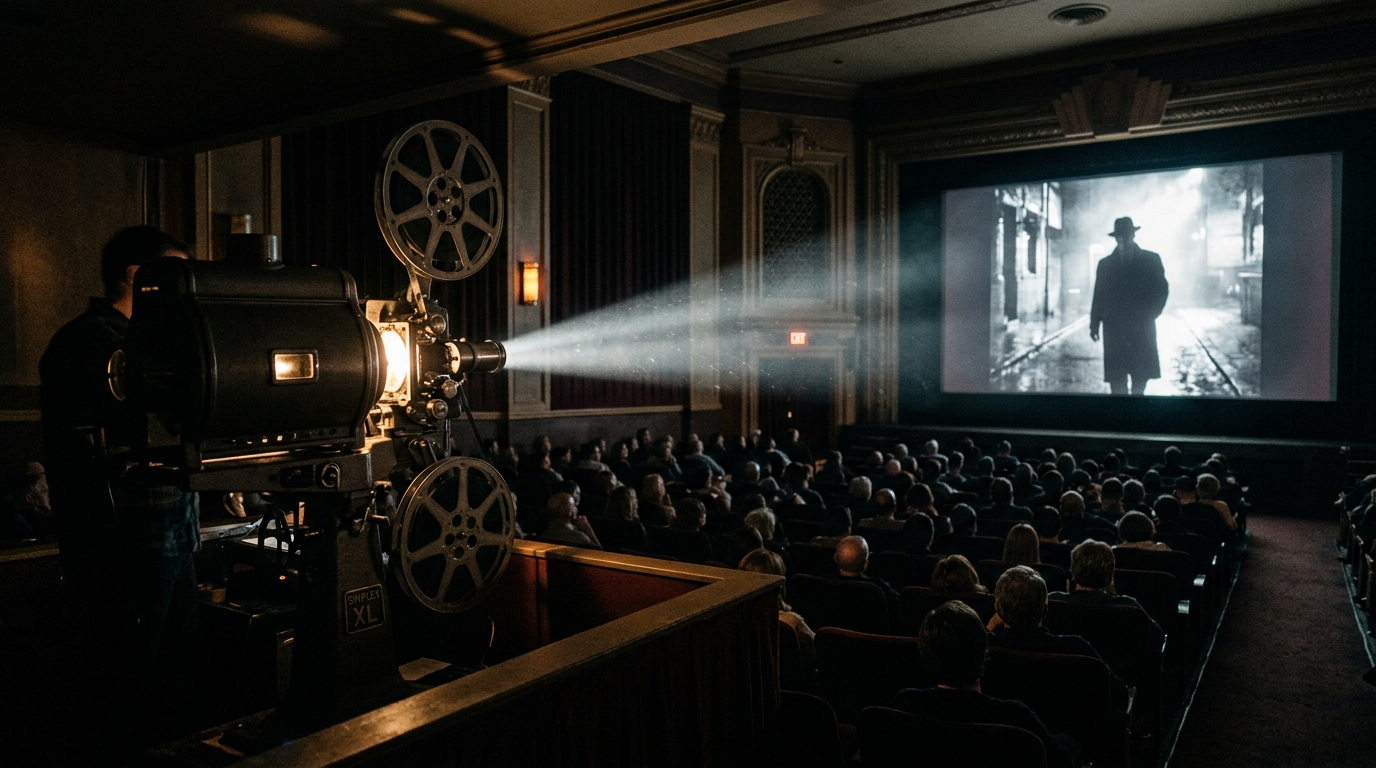
Figure 1.1: The Silver Screen as Political Arena: Projection, Shadow, and Visual Allegory.Source: Cinematic Archive & Cultural Politics Review
Since the centralization of cultural authority under Xi Jinping, the Chinese Communist Party (CCP) has tightened its grip on the film industry (Hale, 2021; Rosen, 2021). Yet, faced with these constraints, filmmakers have developed what might be called "navigational strategies"—formal and generic choices that allow them to stage politically pointed critiques while remaining, formally at least, within the bounds of censorship tolerance.
As demonstrated by films such as Jia Zhangke's A Touch of Sin (2013), Diao Yinan's Black Coal, Thin Ice (2014), and Zhang Yimou's One Second (2020), the deployment of wuxia, noir, and historical melodrama conventions allows for an implicit critique of corruption and social decline (Ashok, 2014; Stone, 2012).
Section II
The Censorship Mechanism: Gatekeeping by a Thousand Cuts
💡 The Big Picture
How does the Chinese movie approval pipeline actually work?
Making a commercial movie in China isn't just about finding cameras and actors; it requires surviving a multi-stage government gauntlet. Under President Xi Jinping, movie oversight was transferred directly to the Party's Central Propaganda Department. Filmmakers must submit their scripts for approval before a single frame is filmed, submit the rough cut for censorship scrutiny, and negotiate unwritten political taboos. Without the final green "Dragon Seal" badge, the movie cannot be shown anywhere in the world.
Key Concept:The Dragon Seal (Longbiao) is the mandatory green animated logo that precedes every public film screening in China, proving it survived the state review board.
Analyzing the methods employed by filmmakers requires a basic understanding of the censorship system itself. The CCP's involvement with film is as old as the People's Republic itself, but censorship has become considerably more robust and institutionalized under Xi Jinping (Rosen, 2021). After securing power and cracking down on perceived corruption, the CCP brought the film industry under direct ideological control due to cinema's immense mass appeal and emotional potency.
Film under the current system must receive approval at multiple distinct stages. The China Film Administration (CFA), led directly by the Central Propaganda Department, controls licensing, production permits, and domestic financing:
The Four-Stage Regulatory GauntletInstitutional Oversight
Stage 1: Script Pre-Approval & Synopsis Vetting: Before pre-production can commence, a complete treatment and screenplay must be submitted to the CFA. Any overt political critique, sympathetic portrayal of dissidents, or depiction of high-level corruption is flagged or rejected at the written stage.
Stage 2: Production Supervision & Provincial Guidance: Regional propaganda bureaus maintain operational oversight over filming locations, requiring permits for sensitive urban or rural backdrops.
Stage 3: Review Board Rough-Cut Screening: The completed work is submitted to a panel of censors who evaluate audio, visual pacing, and thematic alignment against expansive, unwritten "red lines."
Stage 4: Issuance of the Dragon Seal (Longbiao): The coveted animated green seal granting theatrical distribution rights, broadcast clearance, and permission for international festival submission.
Censors operate not from a public, transparent legal code, but from a collection of unspoken "red lines" and fluctuating sensitivity thresholds (Hale, 2021). Categories of prohibited subject matter are expansive, covering negative depictions of government officials, scenes of organized social unrest, religious or ethnic tensions, and historical events the Party prefers to strictly curate—most notably the Cultural Revolution (1966–1976), the Great Leap Forward, and the 1989 Tiananmen Square protests.
Gatekeeping takes place by a thousand cuts: filmmakers must try to read their own censor's mind, constantly guessing at the trigger points while trying to maintain the aesthetic integrity and emotional resonance of their vision. This institutional ambiguity induces an insidious form of pre-emptive self-censorship, yet simultaneously catalyzes sophisticated forms of narrative misdirection.
Section III
Genre as Camouflage: The Aesthetic of Indirection
💡 The Big Picture
Why do filmmakers hide their political critiques inside action and detective movies?
If a director makes a realistic documentary showing police taking bribes or factory workers starving in dirty industrial cities, government censors will immediately ban the film and seize the footage. But if the director wraps that exact same story in a detective thriller (film noir) or a sword-fighting epic (wuxia), the censors look at it and say: "This is just commercial entertainment for popcorn-eaters." By wearing the mask of popular genre, artists smuggle sharp social truths right past the gatekeepers.
Key Concept:Genre Camouflage acts like a cinematic Trojan horse, using popular entertainment formulas to give filmmakers plausible deniability while presenting biting social critiques.
The censorship system is "productive" in that it bends expression rather than extinguishes it. The systemic corruption filmmakers cannot directly depict and the state violence they cannot explicitly show are staged through other aesthetic means—from genre conventions to visual metaphor, and through the rhetorical deployment of absence, ellipsis, and silence. The censorship regime thus inadvertently cultivates an entire aesthetic of indirection and allegory (Chen, 2022).
One of the most potent strategies is weaponizing genre. Genre works like political immunity: a noir detective procedural or a wuxia martial revenge tale can be plausibly presented to the review board as "mere commercial entertainment." A detective noir set in a crumbling post-industrial cityscape draws visceral attention to moral rot and institutional incompetence, which can be excused because such tropes are historically inherent to the noir genre itself. Wuxia, similarly, has for centuries served as an indigenous cultural vessel for narratives of popular resistance to bureaucratic tyranny and feudal oppression. Genre functions as a Trojan horse, smuggling subversive critique past the censor by coding it in the familiar vernacular of mass entertainment.
⚡ Interactive Simulator: Test Filmmaker Navigational Strategies
Select a cinematic strategy below to examine how filmmakers camouflage critique from state censors:
Strategy 1: The Wuxia Allegory (Jia Zhangke - A Touch of Sin)
Generic Shield: Traditional martial arts revenge narrative. Exploits the centuries-old Chinese cultural tradition of the wandering sword fighter (*xia*) defending personal honor against corrupt, predatory local tyrants.
Smuggled Critique: Reframes violent attacks by marginalized rural migrant workers against corrupt village chiefs and factory bosses as righteous retribution, dismantling the state myth of 'Harmonious Society' (hexie shehui).
Genre Framework
Surface Coding (Censor Approval)
Latent Subtext (Smuggled Critique)
Censorship Vulnerability
Wuxia (Martial Knight)
Stylized martial arts action, honor duels, period folklore.
Underclass moral rebellion against corrupt local oligarchs and predatory economic displacement.
Moderate: Permits can be withheld if violence too closely mirrors ongoing viral labor protests.
Neo-Noir (Crime Thriller)
Police hunting a psychotic serial killer across winter rustbelt cities.
Pervasive spiritual decay, institutional breakdown, and the atomization of working-class solidarity.
Low-to-Moderate: Nihilism can be dismissed as atmospheric convention inherent to the noir tradition.
Melodrama & Meta-Cinema
Tearful personal family sacrifice and nostalgic communal love for 35mm celluloid film.
Collective trauma of political persecution, ideological labor camps, and forced historical amnesia.
High: Encounters absolute Party sensitivity thresholds surrounding memory management.
Section IV
Case Study 1: The Wuxia Allegory in A Touch of Sin (2013)
💡 The Big Picture
How did a martial arts myth reframe real-world violence?
In 2013, acclaimed Sixth Generation director Jia Zhangke took four real-life, bloody headlines from Chinese news—miners fighting corrupt village bosses, factory workers driven to despair, sauna workers assaulted by arrogant officials—and turned them into a movie. But instead of showing them as pathetic or criminal, he filmed them using the visual style of ancient swordfighters (*xia*). This flipped the entire political narrative: their violence was not an act of crime, but a heroic response to the state's broken promises of social harmony.
Key Concepts:The Xia (Knight-Errant) is an ancient Chinese hero who breaks laws to enforce cosmic justice; Harmonious Society was the official CCP slogan promising social stability.
Jia Zhangke's A Touch of Sin (2013) deploys this navigational strategy with extraordinary clarity and theoretical precision (Ashok, 2014; Berry, Lu, & Rofel, 2014). Directly inspired by King Hu's 1971 classic A Touch of Zen, the film is structured as an anthology of four loosely interconnected vignettes based on real-life, sensational incidents of violence reported in Chinese newspapers and microblogs:
The Four Contemporary Avatars of the XiaJia Zhangke (2013)
1. Dahai (Shanxi): An alienated coal miner who petitions against the corrupt village chief who privatized the collective mine to purchase private jets and Maserati sports cars. Ignored by municipal authorities and beaten by company thugs, Dahai takes up a hunting rifle to execute the village elite.
2. Zhou San (Chongqing): A disaffected migrant who returns to his impoverished mountain village, finding personal autonomy and power only through an illicit pistol, roaming between boomtowns as a ruthless highwayman.
3. Xiao Yu (Hubei): A receptionist at a bathhouse who is cornered and violently assaulted by wealthy local cadres demanding sexual services while beating her with stacks of cash. Reversing the victim role, she draws a fruit knife and fatally slashes her attackers in the dynamic posture of a classical wuxia swordswoman.
4. Xiao Hui (Dongguan): A young migrant factory laborer who cycles through exploitative assembly lines and decadent red-light district hostess clubs, ultimately leaping to his death under unbearable financial and moral humiliation.
Jia deliberately invokes the aesthetic conventions of the wuxia genre to code these modern acts not as simple antisocial criminality, but as the righteous actions of the xia—the legendary knight-errant who oversteps the statutory law to enforce an unwritten cosmic morality (Berry et al., 2014). By transposing wuxia iconography—stylized camera framings, abrupt bursts of kinetic violence, and archetypal heroic postures—onto contemporary rural-to-urban migrant laborers, Jia reframes individual outbursts of bloodshed as completely rational responses to structural economic injustice and state-backed capitalist exploitation.
"If Jia Zhangke's wuxia-inflected cinema offers an implicit political claim, it is not that harmony is possible, but that it is fundamentally impossible under existing systemic inequality."
This framing enables a devastating subversion of the CCP's core ideological discourse of the "harmonious society" (hexie shehui). Official propaganda insisted that rapid market modernization was lifting all citizens into an orderly, harmonious socialist modernity. A Touch of Sin demonstrates that beneath this glossy veneer lies raw, predatory exploitation where ordinary people are left with no institutional recourse other than the violent code of the ancient sword.
Section V
Case Study 2: Noir & Systemic Decay in Black Coal, Thin Ice (2014)
💡 The Big Picture
How do dirty snow and severed limbs tell the truth about a society?
Diao Yinan's Black Coal, Thin Ice masquerades as a standard detective movie about tracking a mysterious killer who dismembers bodies in a freezing industrial city in northern China. But the real story isn't the murderer; it's the cold, broken city itself. By surrounding the characters with gray skies, decaying coal factories, and sick neon lights, Diao uses the language of film noir to show how rapid economic changes have frozen human empathy and shattered public trust in institutions.
Key Concept:Neo-Noir Decay uses bleak lighting, industrial ruins, and cynical characters to critique modern life without ever uttering a direct political protest.
While Jia Zhangke turned to the mythic past of wuxia, director Diao Yinan turns to Western hardboiled film noir in Black Coal, Thin Ice (Bai Ri Yan Huo, 2014) to give atmospheric voice to the systemic erosion of social trust (Chen, 2022; Rosen, 2021).
On the surface, the film satisfies the conventional requirements of a commercial detective crime thriller: an alcoholic, disgraced ex-policeman named Zhang Zili attempts to redeem his ruined life by investigating a bizarre serial killer who is scattering severed human body parts across coal distribution rail networks throughout northeastern Heilongjiang province.
The Noir Visual Lexicon of Rustbelt DisillusionmentDiao Yinan (2014)
However, the film's true subject is the pervasive atmosphere of spiritual repression, institutional rot, and social alienation in a rustbelt region where state socialist welfare promises have been abandoned to hyper-capitalist indifference.
The film's visual styling—its muted, melancholic tonal palette of soiled snow, industrial charcoal, and sickly neon lighting in rundown dance halls—becomes a sophisticated formal language for expressing collective disillusionment. The dismemberment of the human body across industrial coal routes functions as a profound visual metaphor for the dismemberment of social bonds and mutual human solidarity under predatory modernization.
Diao's mobilization of noir conventions proved remarkably effective because noir arrives with an implicit critique of authority built directly into its generic DNA. Hardboiled detective stories are universally expected to feature morally compromised investigators, ineffective police bureaucracies, and corrupt municipal environments. Consequently, state censors interpreted the film's grim, cynical texture as standard genre compliance rather than a targeted political critique of modern Chinese institutional failure.
The crowning proof of this navigational strategy was the film's triumph at the 64th Berlin International Film Festival, where it won the prestigious Golden Bear for Best Film, and lead actor Liao Fan took the Silver Bear for Best Actor. Diao managed to produce a biting work of sociopolitical critique that passed China Film Administration screening while simultaneously captivating the global art-house circuit.
Section VI
Case Study 3: The Limits of Coding in One Second (2020)
💡 The Big Picture
Why do some political topics resist even the cleverest cinematic camouflage?
Even the most famous and politically connected filmmakers cannot escape censorship when they touch the Party's most sensitive historical scars. In 2019, Fifth Generation master director Zhang Yimou had his film One Second pulled from the Berlin Film Festival just hours before its premiere. The official excuse was "technical reasons," but the real reason was political: the film depicted the harsh reality of forced labor camps and collective trauma during the Cultural Revolution—a historical event over which the Party maintains total narrative control.
Key Concepts:"Technical Reasons" (Jishu Yuanyin) is the state's diplomatic euphemism for political censorship; State Memory Management refers to the Party's monopolization of historical trauma.
If A Touch of Sin and Black Coal, Thin Ice demonstrate the expansive creative potential of genre camouflage, Zhang Yimou's One Second (Yi Miao Zhong, 2020) illustrates the definitive, unyielding boundaries of that coding (Stone, 2012; Hale, 2021).
Zhang, arguably China's most internationally celebrated Fifth Generation auteur, conceived One Second as a deeply personal love letter to cinema itself. Set during the turbulent years of the Cultural Revolution (1966–1976) in the remote Gobi desert of northwestern China, the narrative tracks an escaped labor camp prisoner who risks his life to travel across the wasteland simply to watch a state newsreel that contains exactly one second of celluloid footage of his estranged daughter.
The Berlin Withdrawal & Mandatory ReshootsCensorship Intervention
The film establishes cinema as an intimate repository of human grief, memory, and spiritual survival, directly contrasting the emotional yearning of ordinary citizens with the blaring, dogmatic socialist newsreels distributed by state propagandists.
However, the film's implicit treatment of the Cultural Revolution as an era of profound collective trauma, senseless persecution, and physical deprivation proved unacceptable to Party censors under Xi Jinping's tightened memory regime.
Originally scheduled to have its world premiere in competition at the 69th Berlin International Film Festival in February 2019, the film was abruptly canceled and pulled from the program days before screening. The official explanation cited vague "technical difficulties encountered during post-production"—a universally understood diplomatic euphemism for state censorship intervention.
Following the international festival withdrawal, Zhang Yimou was forced to spend over eighteen months executing mandatory re-edits and reshooting key scenes in the desert. Critical narrative elements were altered: dialogue explaining that the daughter had died in a tragic work-brigade accident while attempting to prove her ideological loyalty to the Party was suppressed and softened, and a mandatory uplifting epilogue was appended to reassure audiences of post-Mao national rejuvenation.
The case of One Second demonstrates the absolute limits of aesthetic coding. While contemporary inequality and fictional crime can be negotiated through the camouflage of genre, sensitive historical periods—where the CCP exercises strict state memory management—remain non-negotiable. When formal indirection collides with foundational taboos of historical legitimacy, raw state power inevitably overrules cinematic nuance.
Synthesis: Generative Friction in the SubtextTheoretical Conclusion
The history of the CCP’s political censorship is not a simple story of black-and-white repression and resistance. It is a dynamic, ongoing negotiation in which state control paradoxically engenders formal richness. When unable to represent realities directly, films develop alternative languages: noir visual styles stage institutional decay, and wuxia tropes represent desperation as heroism.
Taken as a whole, the case studies suggest that the Chinese filmmaker’s relationship to the state is one of volatile and generative friction. In forcing the logic of social critique into the subtext, the censorship regime has created a cinema of profound subtlety, where the "unsaid" speaks with far more resonance than the dialogue.
🧠 Interactive Knowledge Check
Test your mastery of the monograph's core concepts on Chinese cinema censorship:
1. According to media scholar Thomas M. Chen in Made in Censorship, how does state regulation function in contemporary Chinese cinema?
2. In A Touch of Sin (2013), how does Jia Zhangke deploy the conventions of the classical wuxia genre to stage a political critique?
3. Why was the film noir genre particularly effective as 'political camouflage' for Diao Yinan's Black Coal, Thin Ice (2014)?
4. What critical lesson regarding the boundaries of censorship does Zhang Yimou's One Second (2020) reveal?
Academic References & Primary Sources
Ashok, G. (2014). "A touch of sin: Grim and compelling." The Diplomat.
Berry, C., Lu, X., & Rofel, L. (Eds.). (2014). Violence, wuxia, migrants: Jia Zhangke's cinematic discontent in A Touch of Sin. Asian American Studies Department Faculty Scholarship.
Chen, T. M. (2022). Made in censorship: The Tiananmen movement in Chinese literature and film. New York: Columbia University Press.
Hale, C. (2021). "Film in the age of Xi: Censorship practices in contemporary Chinese cinema." Journal of Media Studies, 34(2), 145–168.
Rosen, S. (2021). "Censor's dilemma: Film in the era of Xi Jinping." In D. C. Kang (Ed.), China's grand strategy. Washington, D.C.: Brookings Institution Press.
Stone, A. (2012). "Zhang Yimou's long road home." Boston Review.
</section>
Concept Primer
Term
Academic definition goes here...
Why it matters and real-world analogy...
]]>The Architecture of Primacy: America's Rise, Global Interventions, and Alliance Strains2026-09-17T00:00:00+00:002026-09-17T00:00:00+00:00https://cijamie.github.io/posts/the-architecture-of-primacy
Monograph Series: Geopolitics & Diplomatic History
Scope: 1776–2026 Analytical Overview
Methodology: Historical Institutionalism & Data Synthesis
A Comprehensive Empirical Analysis of America's Rise, Global Interventions, and Contemporary Alliance Strains
~50%
U.S. Share of World Mfg.
(1945 Baseline)
Click for context ↗
469+
Military Interventions
(1798–2022 Overseas)
Click for context ↗
64
Covert Cold War Coups
(1947–1989 CIA Ledger)
Click for context ↗
25M+
Lives Saved Globally
(Via PEPFAR Aid)
Click for context ↗
Section I
Introduction: The Anomalous Superpower
💡 The Big PictureReading Lens
How did a tiny coastal colony turn into the world's greatest economic giant?
In 1776, America was just a small group of 13 agricultural colonies with only 2.5 million people and almost no share of global wealth, while China and Britain ruled global trade. Yet just 170 years later, after World War II, the United States held 60% of all the world's gold, built half of everything made on Earth, and had the only atomic weapons. This wasn't luck: it was the result of favorable geography, European self-destruction during two world wars, a newly invented global economic order, and massive technological innovation.
Key Concept:Hegemony refers to a dominant superpower that sets the rules and guarantees the security of the international order.
In July 1776, the United States was an improvised coalition of thirteen agrarian colonies scattered along the North American Atlantic coast, harboring an aggregate population of barely 2.5 million people (of whom nearly 20% were enslaved). Hemmed in to the west by the Appalachian barrier and vast territories claimed by the British, French, and Spanish empires, its economic output constituted less than 0.5% of estimated world GDP. In contrast, Qing Dynasty China accounted for an estimated 32.9% of global economic output (Maddison, 2007), while Great Britain was pioneering the steam-driven mechanization that would anchor the British Empire across a quarter of the Earth’s surface.
Yet within 170 years, a blink in the chronology of human civilizations, the United States had shattered all historical precedents of imperial ascension. By August 1945, the U.S. held over 60% of the world's official monetary gold reserves, generated nearly half of total global manufacturing production, possessed a monopoly on atomic weapons, and maintained an unassailable blue-water naval fleet larger than the combined navies of all other sovereign states combined (Kennedy, 1987).
How did an upstart republic eclipse ancient civilizations and modern empires alike? Geopolitical theorists and economic historians demonstrate that America's rise was not an accident of moral exceptionalism, but the compounding confluence of four deterministic forces: unrivaled natural geography, the self-immolation of the European balance of power across two total wars, the systemic design of a multilateral institutional order, and an absorptive innovation ecosystem.
Section II (Part 1)
The Determinants of Ascendance: Foundations of American Hegemony
💡 The Big Picture
Geographic Luck & The European "Thirty Years' War"
The United States hit the geographic lottery: two massive oceans protect it from invasion, its neighbors (Canada and Mexico) never posed existential military threats, and the Mississippi river system let farmers and factories move goods ten times cheaper than overland wagons. While European empires bombed their own cities and factories to dust between 1914 and 1945, the U.S. homeland remained completely untouched, tripling its industrial output and becoming the undisputed creditor of the world.
1. Geographic Hegemony and the Oceanic Moat
As geopolitical analyst Peter Zeihan demonstrates in The Accidental Superpower (2014), the physical topography of North America granted the United States an insurmountable structural advantage over any Eurasian rival.
First, the continental landmass is insulated by two vast oceanic buffers: the Atlantic (averaging 3,000 miles) and the Pacific (spanning over 5,000 miles). This geographic endowment effectively neutralized the threat of sustained amphibious invasion following the War of 1812. Furthermore, unlike European or Asian empires burdened with hostile, heavily populated bordering states, the United States faced neighbors that could never contest its continental dominance: Canada, constrained by arctic permafrost and low demographic density, and Mexico, fragmented by the arid Sonoran desert and rugged Sierra Madre mountain ranges.
Second, the continental United States hosts the Mississippi-Missouri River Basin, which encompasses over 12,350 miles of naturally interconnected navigable waterways. Waterborne freight historically cost roughly one-tenth the cost of overland wagon transport. Decades before the advent of the steam locomotive, early American settlers could ship bulk agricultural output and raw timber from the Midwest to oceanic ports in New Orleans and the Eastern seaboard at negligible cost. This geographic circulatory system forged a continent-sized domestic free-trade zone that enabled unprecedented capital accumulation.
2. The Cataclysm of the European Wars (1914–1945)
Prior to 1914, London was the planetary nucleus of sovereign finance, the Pound Sterling was the preeminent global trade currency, and continental Europe was the technological workshop of the world. Great Britain held net overseas foreign investments exceeding £4 billion (roughly $20 billion at the time), functioning as the globe's ultimate creditor nation (Ferguson, 2001).
The outbreak of World War I (1914–1918) and World War II (1939–1945) shattered this framework in what historians describe as a Thirty Years' War of European self-destruction:
During WWI, the British Treasury liquidated over £1 billion of foreign equity assets and accumulated over $4 billion in debt owed directly to the United States Treasury and Wall Street syndicates led by J.P. Morgan. By the end of WWII in 1945, Britain’s national debt had ballooned to over 250% of GDP, and its physical shipping merchant fleet had been decimated by U-boat warfare. Continental Europe lay in complete ruins: German industrial production had collapsed by over 70% from pre-war baselines, Soviet infrastructure across Ukraine and Western Russia was comprehensively leveled, and urban centers across France, Italy, and Poland were devastated.
Conversely, mainland United States infrastructure suffered zero physical wartime devastation. Mobilizing under the War Production Board, U.S. industry constructed 297,000 aircraft, 86,000 tanks, and over 50 million deadweight tons of merchant shipping between 1940 and 1945 alone. When the war concluded, U.S. GDP had expanded from $101 billion in 1940 to over $228 billion in 1945. The United States was no longer merely a participant in the global balance of power; it had become the balance itself.
Section II (Part 2)
Architect of the Post-War Operating System
💡 The Big Picture
Writing the Rules of the World: Money, Security, and Trade
Instead of going into isolation after WWII, the U.S. built the "operating system" for world commerce. It made the U.S. Dollar the world's currency (Bretton Woods), formed NATO to shield Europe and Asia under an American nuclear defense umbrella, and used its Navy to protect cargo ships everywhere so countries like Japan, South Korea, and later China could grow wealthy through peaceful trade.
Rather than retreating behind protectionist tariff barriers as it did following the 1919 Treaty of Versailles, the Roosevelt and Truman administrations deliberately constructed the institutional architecture of global governance:
The Bretton Woods Monetary Framework (1944): Convening in New Hampshire, delegates from 44 nations established the International Monetary Fund (IMF) and the International Bank for Reconstruction and Development (World Bank). The U.S. Dollar was formally designated the world’s anchor reserve currency, pegged to gold at $35 per ounce, with all other currencies pegged to the dollar. Even following President Nixon’s 1971 closure of the gold window, the dollar retained its hegemony via the 1974 U.S.-Saudi agreement to price all OPEC crude oil exclusively in USD (the "petrodollar" system).
The Security Umbrella & Collective Defense: The North Atlantic Treaty Organization (NATO), established in April 1949 with Article 5 as its mutual-defense bedrock, brought Western Europe under the U.S. nuclear umbrella. Bilateral mutual defense treaties with Japan (1951) and South Korea (1953) placed East Asian security under American military oversight.
Freedom of Navigation & the Global Commons: The United States Navy deployed carrier strike groups across twelve maritime choke points (including the Straits of Malacca, Hormuz, and Gibraltar), guaranteeing unmolested maritime transit to all peaceful vessels. By underwriting the security of maritime commerce, Washington enabled the export-led growth models of post-war Japan, South Korea, Taiwan, and eventually Deng Xiaoping's China.
4. Demographic Absorptive Capacity and Technological Pull
Unlike closed or ethnically homogeneous nations, the U.S. harnessed continuous waves of high-skill and labor immigration. From 1930 to 1950, European intellectual refugees, including Albert Einstein, Enrico Fermi, Leo Szilard, and John von Neumann, decisively won the race for the atomic bomb and established early dominance in rocketry, computing architecture, and quantum physics.
This intellectual influx combined with the world's deepest capital markets: by 1980, the venture capital ecosystems of Silicon Valley, Route 128 in Massachusetts, and Wall Street mobilized risk capital at volumes an order of magnitude higher than European state banks or Japanese zaibatsu successors, driving the microchip, Internet, telecommunications, and modern artificial intelligence revolutions.
Section III
The Paradox of American Engagement: Rebuilding vs. Intervention
💡 The Big Picture
The Two Faces of American Power
Here is the central paradox of U.S. history: on one hand, the U.S. poured billions into saving lives, rebuilding shattered nations like post-war Germany and Japan into rich democracies, and curing AIDS in Africa (saving 25 million lives via PEPFAR). On the other hand, out of Cold War fears of communism and corporate profits, the CIA secretly overthrew 64 foreign governments (covert regime change), often crushing newly elected democracies in places like Iran, Guatemala, and Chile.
The exercise of American primacy across the 20th and 21st centuries is defined by a central historical paradox: the United States has deployed unprecedented resources to reconstruct devastated societies and preserve global health, while simultaneously executing hundreds of covert and overt interventions that violated sovereign borders, toppled democratically elected heads of state, and destabilized entire regions.
Intervention Mechanism
Empirical Scale
Key Historical Case Studies & Primary Data Sources
Bilateral Economic & Humanitarian Aid
140–150 nations annually; over $1.5 trillion since 1945
Marshall Plan (1948–1951): Disbursed $13.3 billion ($155B+ adjusted) across 16 European nations (Milward, 1984). PEPFAR (2003–Present): $110B+ allocated; 25M+ lives saved; 20.5M provided with antiretroviral treatment (U.S. State Dept, 2024).
Japan (1947): General Douglas MacArthur's GHQ drafted the pacifist Post-War Constitution with Article 9. West Germany (1949): Allied High Commission oversaw the Grundgesetz. Iraq (2005): Coalition Provisional Authority oversight.
Documented by Dr. Lindsey O'Rourke (Covert Regime Change, Cornell Univ. Press, 2018). Key episodes: Iran (Operation Ajax, 1953), Guatemala (Operation PBSuccess, 1954), Cuba (Operation Zapata, 1961), and Chile (Track II, 1970–73).
Partisan Electoral Interference
81 foreign elections (1946–2000)
Empirical dataset compiled by Dr. Dov Levin (Carnegie Mellon Univ., 2016). Interventions occurred across 45 countries, including covert funding for Christian Democrats in Italy (1948) and Eduardo Frei in Chile (1964).
Where American occupation coincided with established institutional foundations, intervention generated democratic and industrial miracles:
Japan (1945–1952): From Ruin to Industrial TitanInstitutional Overhaul
The Supreme Commander for the Allied Powers (SCAP), led by General Douglas MacArthur, enacted comprehensive land reforms that redistributed over 5 million acres of agricultural land from absentee landlords to tenant farmers, dismantled the militaristic zaibatsu conglomerates, enfranchised Japanese women, and drafted the 1947 Constitution in just eight days.
Article 9 explicitly forbade the maintenance of land, sea, and air forces with war-making potential. Under the American security umbrella, Japan diverted its gross domestic capital away from military spending and into high-tech manufacturing, generating the "Post-War Japanese Miracle."
South Korea (1950–Present): The Shield for the Han River MiracleMutual Defense Treaty
U.S.-led UN forces sustained 36,574 combat deaths to halt North Korean forces at the 38th Parallel. Although Washington supported authoritarian dictatorships under Syngman Rhee and General Park Chung-hee for decades in the name of anti-communist containment, the security treaty signed in 1953 granted South Korea the physical shield necessary to execute the "Miracle on the Han River," ultimately transitioning into a vibrant consolidated democracy in 1987.
The inverse side of containment was catastrophic for democratic stability across the Global South (O'Rourke, 2018):
Operation Ajax (Iran, 1953)Oil & Autocracy
The CIA and British MI6 engineered the overthrow of Iran's democratically elected Prime Minister Mohammad Mossadegh after the Iranian parliament voted to nationalize the British-owned Anglo-Iranian Oil Company.
The restoration of Mohammad Reza Pahlavi’s authoritarian rule, backed by the brutal SAVAK secret police, spawned deep anti-imperialist sentiment that erupted in the 1979 Iranian Revolution, permanently destabilizing Middle Eastern security (Kinzer, 2003).
Following President Jacobo Árbenz’s enactment of Decree 900, which expropriated uncultivated lands owned by the American multinational United Fruit Company with financial compensation, the CIA organized a paramilitary invasion, forcing Árbenz’s resignation.
The coup installed Colonel Carlos Castillo Armas, sparking a 36-year civil war that cost over 200,000 civilian lives, predominantly indigenous Maya (CEH, 1999).
Declassified CIA records confirm President Richard Nixon ordered CIA Director Richard Helms to "make the economy scream" following the democratic election of Marxist physician Salvador Allende.
"Make the economy scream.", President Richard Nixon to CIA Director Richard Helms (Declassified Cold War memo)
Covert funds funneled into strikes, right-wing media outlets, and military plotters culminated in the September 11, 1973 coup led by General Augusto Pinochet, whose military junta murdered over 3,000 citizens and tortured tens of thousands.
Section IV
The Realignment: Transactional Foreign Policy and Alliance Strain
💡 The Big Picture
From "Mutual Defense" to "Show Me the Money"
For 70 years, both Democrats and Republicans treated alliances like NATO and bilateral treaties with Japan and South Korea as long-term investments in world peace. The Trump "America First" doctrine broke this consensus: it treated treaties like business spreadsheets. Allies who didn't pay 2% of their GDP on defense were called "delinquent," tariffs were slapped on democratic allies just like rivals, and South Korea saw the U.S. demand a 400% payment hike. As a result, allies in Europe and Asia are now debating building their own armies and nuclear weapons.
The institutionalist framework that defined American primacy for over seven decades faced an unprecedented structural disruption with the rise of Donald Trump and the institutionalization of the "America First" foreign policy doctrine.
Historically, both Democratic and Republican administrations treated alliances like NATO, the KORUS Mutual Defense Treaty, and the U.S.-Japan Security Treaty as public goods that served long-term American national security. In sharp contrast, the Trump foreign policy doctrine treats international agreements as bilateral balance sheets, conditioned on financial contributions and immediate trade parity.
1. The Demolition of Collective Security Assurances
The bedrock of the North Atlantic Treaty is Article 5, which posits that an armed attack against one member state shall be considered an attack against all. The credibility of deterrence relies entirely on the perception that the American nuclear triad stands unconditionally behind allied capitals.
Trump directly disrupted this principle. He publicly warned that if European allies failed to meet NATO's 2014 Wales Summit target of allocating 2% of GDP to defense expenditures, the United States would refuse to defend them in the event of Russian aggression, even asserting he would encourage an adversary to "do whatever the hell they want" to nations deemed "delinquent" (Trump Campaign Address, Feb 2024).
While this pressure did induce substantial European defense budget increases, NATO reported that 23 of 32 member states met the 2% GDP benchmark by late 2024, up from just 3 nations in 2014, it severely damaged allied confidence in the permanence of the U.S. security guarantee. In Berlin, Paris, and Warsaw, policymakers have accelerated the push for European Strategic Autonomy, actively preparing for a geopolitical environment in which the United States ceases to function as Europe’s ultimate protector.
2. Universal Weaponization of Tariffs Against Treaty Allies
For 70 years, Washington maintained an explicit separation between economic friction and national security alliances. Tariffs were occasionally levied through the multilateral disputes mechanism of the World Trade Organization (WTO).
The Trump administration erased this boundary by invoking Section 232 of the Trade Expansion Act of 1962, declaring that steel and aluminum imports from the European Union, Canada, Japan, and South Korea constituted an imminent threat to U.S. national security. By placing allies in the same regulatory category as strategic adversaries like the People's Republic of China, Washington signaled that decades of mutual military alliance provided zero insulation against American protectionism.
Furthermore, threats to impose universal baseline tariffs of 10% to 20% across all imported goods, alongside specific 25% to 100% tariffs on automotive and semiconductor supply chains, have fractured global trade cohesion. In response, long-standing partners have drafted retaliatory tariff packages, challenged American measures at the WTO, and established trade pacts, such as the Comprehensive and Progressive Agreement for Trans-Pacific Partnership (CPTPP) and the Regional Comprehensive Economic Partnership (RCEP), that deliberately exclude the United States.
3. Friction with East Asian Bilateral Pacts: South Korea and Japan
In Northeast Asia, where forward-deployed American troops serve as a direct tripwire against North Korean aggression and Chinese naval expansion, transactional diplomacy generated profound strategic anxiety:
Special Measures Agreement (SMA) Demands: In negotiations with South Korea, the Trump administration demanded an immediate 400% increase in Seoul's host-nation financial support, requesting nearly $5 billion annually for the stationing of 28,500 U.S. personnel. When Seoul balked, threats of unilateral troop drawdowns surfaced.
Unilateral Diplomatic Concessions: Following the 2018 Singapore Summit with North Korean leader Kim Jong Un, President Trump unilaterally canceled joint U.S.-South Korean military exercises ("war games"), calling them "provocative" and "expensive," without prior consultation with the Blue House or the Pentagon.
The Independent Nuclear Proliferation Debate: The unpredictable nature of Washington’s extended deterrence commitments catalyzed unprecedented shifts in public and elite opinion. Comprehensive polling conducted by the Chicago Council on Global Affairs (2022–2024) revealed that over 70% of the South Korean public now favors South Korea developing its own sovereign nuclear weapons program rather than relying exclusively on the American nuclear umbrella.
4. The Systemic Withdrawal from Multilateral Architecture
The institutional primacy constructed at Bretton Woods and San Francisco relied on American stewardship of the rules of international conduct. By formally withdrawing from the Trans-Pacific Partnership (TPP), the Paris Climate Agreement, the Joint Comprehensive Plan of Action (JCPOA / Iran Nuclear Deal), and the World Health Organization (WHO), and by paralyzing the World Trade Organization by blocking all appointments to its Appellate Body, the U.S. transitioned from the world's primary rulemaker to its most unpredictable revisionist power.
Section V
Competing Geopolitical Perspectives: Two Visions of Hegemony
💡 The Big Picture
Clash of Grand Strategies: Global Cop vs. America First
This isn't just about politicians disliking each other, it's an intellectual battle between two completely opposite ways of seeing the world. Liberal Internationalism believes helping allies and keeping world trade free protects America in the long run. Offshore Realism / America First believes the world is a cutthroat arena where international treaties tie America's hands while other countries free-ride on our defense spending.
The ongoing transformation of American foreign policy cannot be simplified into a debate between competence and incompetence; it represents a deep, irreconcilable clash between two fundamental schools of Grand Strategy:
American security and economic prosperity depend on an open, rules-based multilateral system underwritten by U.S. power.
The international system is purely anarchic; multilateral bodies dilute sovereignty; interactions should be strictly zero-sum bilateral transactions.
View of Treaties & NATO
Alliances are vital force multipliers that prevent the emergence of a Eurasian hegemon at minimal net cost to U.S. taxpayers.
Alliances are costly encumbrances allowing wealthy foreign states to "free-ride" on American defense while running large trade surpluses.
Trade & Global Markets
Free trade integrates economies, deters armed conflict, and preserves the U.S. Dollar as the global reserve currency (Krasner, 1976).
Persistent trade deficits reflect national decline; tariffs are necessary levers of coercion to repatriate industrial capacity and supply chains.
Strategic Risk
Prone to mission creep, endless peripheral counterinsurgencies (e.g., Iraq, Afghanistan), and ballooning national debt.
Destabilizes allied deterrence, encourages nuclear proliferation, and accelerates a global pivot toward alternative institutions (e.g., BRICS).
⚡ Test the Doctrines: Click a Real-World Crisis Scenario
Scenario: An adversary threatens a NATO border state
Liberal Internationalism: U.S. invokes Article 5 immediately, reinforces forward deterrence troops, and declares an attack on one is an attack on the whole alliance. The cost of defending Estonia is negligible compared to the cataclysm of European instability.
Offshore Realism / America First: U.S. questions whether the ally has paid its 2% of GDP defense benchmark. If "delinquent," Washington threatens non-intervention or demands cash compensation, treating alliance guarantees as a paid transaction rather than a moral covenant.
Section VI & VII
Conclusion: The Sunset of the Hegemonic Pax?
The United States achieved global hegemony through an unprecedented alignment of natural geography, European collapse, technological dominance, and deliberate institutional design. Over eight decades, the American imperium guaranteed the freedom of the maritime commons, underwrote global currencies, rebuilt defeated adversaries into democratic economic powerhouses, and disbursed hundreds of billions in life-saving humanitarian aid.
Yet that same hegemony left an indelible trail of democratic subversion, armed invasions, and destabilized states across Latin America, the Middle East, and Southeast Asia. Today, as domestic exhaustion from decades of foreign entanglements meets rising national debt and intense populist re-evaluation, the foundational pillars of the post-WWII Pax Americana are fracturing.
Whether through purposeful transactional dismantling from within or systemic challenges from emerging multipolar coalitions like China and the BRICS bloc from without, the era of unquestioned, rules-based American hegemony is transitioning into a fragmented, competitive, and far more volatile global order. The American Century was not a permanent law of nature; it was a discrete historical epoch, and its institutional architecture is now facing its ultimate stress test (Allison, 2017).
🧠 Interactive Knowledge Check
Test your grasp of the monograph's core geopolitical principles:
1. Why did the Mississippi-Missouri River Basin give the early United States an enormous economic advantage over European rivals?
2. What is the fundamental difference between the "Liberal Internationalist" and "America First" view of NATO?
3. How did the 1974 U.S.-Saudi Petrodollar agreement preserve dollar dominance after Nixon took the U.S. off the gold standard in 1971?
Academic References & Primary Data Sources
Allison, Graham. (2017). Destined for War: Can America and China Escape Thucydides’s Trap? New York: Houghton Mifflin Harcourt.
CEH (Historical Clarification Commission). (1999). Guatemala: Memory of Silence (Report of the Commission for Historical Clarification). United Nations Office for Project Services.
Ferguson, Niall. (2001). The Cash Nexus: Money and Power in the Modern World, 1700–2000. New York: Basic Books.
Kennedy, Paul. (1987). The Rise and Fall of the Great Powers: Economic Change and Military Conflict from 1500 to 2000. New York: Random House.
Kinzer, Stephen. (2003). All the Shah's Men: An American Coup and the Roots of Middle East Terror. Hoboken, NJ: John Wiley & Sons.
Krasner, Stephen D. (1976). "State Power and the Structure of International Trade." World Politics, 28(3), 317–347.
Levin, Dov H. (2016). "Partisan External Electoral Intervention: Why, When, and What Effects?" International Studies Quarterly, 60(2), 189–202.
Maddison, Angus. (2007). Contours of the World Economy 1–2030 AD: Essays in Macro-Economic History. Oxford: Oxford University Press.
Milward, Alan S. (1984). The Reconstruction of Western Europe, 1945–51. Berkeley: University of California Press.
O'Rourke, Lindsey A. (2018). Covert Regime Change: America’s Secret Cold War. Ithaca, NY: Cornell University Press.
Torreon, Barbara Salazar, & Plagakis, Sofia. (2022). Instances of Use of United States Armed Forces Abroad, 1798–2022. Washington, D.C.: Congressional Research Service (CRS Report R42738).
Tufts University. (2023). The Military Intervention Project (MIP) Dataset (1776–2022). Center for Strategic Studies, The Fletcher School of Law and Diplomacy.
Zeihan, Peter. (2014). The Accidental Superpower: The Next Generation of American Preeminence and the Coming Global Disorder. New York: Twelve/Hachette Book Group.
U.S. Department of State. (2024). PEPFAR Latest Global Results & Impact Report. Washington, D.C.: Office of the U.S. Global AIDS Coordinator.
</section>
Concept Primer
Term
Academic definition goes here...
Why it matters and real-world analogy...
]]>Algorithmic Extremism: Leaderless Radicalization and the New Landscape of Domestic Terrorism2026-09-17T00:00:00+00:002026-09-17T00:00:00+00:00https://cijamie.github.io/posts/algorithmic-extremism-leaderless-radicalization
Monograph Series: Domestic Counterterrorism & Digital Insurgency
Scope: 1995–2026 Comparative Case Synthesis
Methodology: Critical Discourse Analysis (CDA) & Method of Difference
By Jamie Sessions, University of Idaho • Leaderless Radicalization, the "Manosphere," and the Structural Mismatch in Federal Threat Management
0
Central Commanders
(Pure Leaderless Matrix)
Click for context ↗
3
Comparative Eras
(1995 OKC → 2018 Toronto)
Click for context ↗
4
Puzzle Dimensions
(Grievance, Network, Ideology, Platform)
Click for context ↗
Poe
Poe's Law Dilemma
(Irony & Shitposting vs. Intent)
Click for context ↗
Section I
Introduction: The Flattening Architecture of Domestic Extremism
💡 The Big PictureReading Lens
How did domestic terrorism shift from secret militias to solo internet actors radicalized by algorithms?
In the 20th century, stopping a terrorist group meant finding its headquarters, listening to its phone calls, and arresting its leader. Today, violent extremism looks completely different: there are no headquarters, no uniforms, and no human commanders barking orders. Instead, young men sitting alone in their bedrooms are drawn into online echo chambers where recommendation algorithms feed them increasingly extreme content. This study explains how computer algorithms have replaced human generals, and why traditional law enforcement is struggling to stop these "scattered," unpredictable attacks.
Key Concept: In stochastic terrorism, mass digital communication makes violent attacks statistically certain to happen somewhere in society, even though no one can predict exactly which individual will strike next.
When discussing domestic threats to security, the landscape of modern terrorism looks drastically different than that of the previous century. Traditional acts of domestic terrorism in America once mirrored the hierarchical structures described by Bruce Hoffman (2006), entailing established groups with central leadership, formal training infrastructure, and set orders to follow. A key feature of late 20th-century extremist groups was their reliance on tangible resources and discreet person-to-person contact, which made them significantly easier for federal authorities to monitor, infiltrate, and disrupt through "structural change" policies.
However, the digital age has precipitated the rise of diffuse, online-centric networks, effectively flattening the architecture of radicalization. Particularly disturbing is the rise of the "Manosphere." Using the foundational framework proposed by J.M. Berger (2018), these amorphous ideological movements can be defined as extremist because they view the success and survival of their "in-group" (men) as being inseparable from hostile action against an "out-group" (women and feminists). This digital environment creates what researchers identify as radical filter bubbles (Reed et al., 2019), where automated platform algorithms curate an individualized, escalating extremist experience.
From its origins as an online support group, the Incel (involuntary celibate) subculture has evolved into a significant instigator of domestic political violence. The community's radicalization is driven by what Ted Gurr (1970) identifies as relative deprivation: the psychological tension created by a perceived discrepancy between value expectations and value capabilities. In the Incel context, this manifests as a sense of aggrieved entitlement regarding social and sexual status, leading to a Blackpill nihilism where violence is presented as a justifiable reaction to perceived social marginalization.
The Incel movement lacks a physical presence or official doctrine; instead, it relies on peer-to-peer radicalization across modern digital platforms. By decentralizing the pipeline, the movement has adapted the strategy of leaderless resistance, a concept historically associated with far-right figures like Louis Beam (1992) but now perfected by anonymous digital actors. This creates a stochastic environment where individuals are independently inspired to act, directly challenging the conventional frameworks through which federal law enforcement agencies understand and disrupt mass violence.
The Central Research Inquiry: How has the transition from hierarchical terrorist organizations to decentralized, "leaderless" radicalization on digital platforms altered the lethality of domestic political violence in the U.S., and to what extent does this evolution signify a failure of traditional federal threat-management models to adapt to non-linear radicalization pathways?
Answering this inquiry requires a multidisciplinary approach combining sociological perspectives with tactical policy assessments. Understanding the role of modern online networks requires an analysis of radicalization through the "leaderless" framework, drawing on the historic debate between Bruce Hoffman (2006) and Marc Sageman (2008) regarding the transition from centralized command to ad-hoc, horizontal networks. Furthermore, by analyzing specific Incel-related attacks, we can apply Andrew Kydd and Barbara Walter's (2006) strategies of terrorism to determine whether a decentralized approach results in a higher frequency of scattered attacks or a shift toward high-casualty, single-attacker strikes.
By examining shifts in Department of Justice (DOJ) and Federal Bureau of Investigation (FBI) doctrine, we expose a stark institutional mismatch between conventional crime-fighting methods, which prioritize structural decapitation, and the fluid realities of modern, non-linear digital extremism. The central thesis of this research is that the move to decentralized online radicalization is not merely a byproduct of technological convenience, but an organic strategic adaptation that circumvents federal counterterrorism mechanisms.
Section II
Psychological Engines: Relative Deprivation and Aggrieved Entitlement
💡 The Big Picture
Why do people turn to violent extremism? The gap between entitlement and reality
Decades ago, political scientist Ted Gurr discovered that people don't rebel simply because they are poor; they rebel when there is a massive gap between what they believe they are justifiably entitled to and what they can actually achieve. In the online "Manosphere," this psychological gap becomes "aggrieved entitlement": the belief that men are naturally entitled to sexual and social dominance, and that women and modern society have unfairly "stolen" this status from them. When this frustration hardens into the "Blackpill," users believe the world is permanently rigged and that only nihilistic destruction can settle the score.
To understand the modern Incel movement, one must first establish the psychological incentive for civil violence. Scholars of political violence have long argued that radicalization is not a random psychological malfunction, but an intelligible response to perceived systemic failure. Ted Gurr's foundational theory of relative deprivation (1970) provides the primary analytical lens for this phenomenon.
Gurr argues that collective violence is a function of the widening tension between an individual's "value expectations", the goods, rights, and conditions of life to which individuals believe they are justifiably entitled, and their "value capabilities", the goods and conditions they perceive themselves capable of attaining or maintaining. When this gap widens into an unbridgeable chasm, the resulting psychological frustration translates into aggressive political or social behavior.
1. From Economic Deprivation to "Aggrieved Entitlement"
While Gurr's original mid-20th-century scholarship focused primarily on macroeconomic status, class disparities, or denied political enfranchisement, contemporary scholars have demonstrated that relative deprivation operates with equal force across social and cultural hierarchies. In the context of the Incel subculture, relative deprivation is filtered through what sociologist Michael Kimmel and scholar Rachel Guy (2021) define as aggrieved entitlement.
Within the Manosphere, radicalization does not stem from absolute material deprivation or physical starvation. Rather, it is rooted in a perceived loss of social and sexual supremacy. Guy observes that Incel ideology performs a collective "diagnosing" of the contemporary world: it frames liberal democracy and feminism as a hostile "gynocentric dictatorship" that has illegitimately stripped men of their natural, ancestral social standing.
The Mechanics of Aggrieved EntitlementTheoretical Framework
1. Value Expectation: The internalized assumption that male identity inherently confers social respect, romantic partnership, and sexual validation as a natural birthright.
2. Perceived Capability Failure: The acute experience of romantic rejection, social isolation, and perceived physical inadequacy within competitive modern dating dynamics.
3. Diagnostic Out-Group Scapegoating: Projecting personal shortcomings outward onto a designated enemy class, specifically women, feminists, and sexually successful men ("Chads"), framing personal alienation as systemic oppression.
2. The "Blackpill" as an Ideological Point of No Return
The extreme ideological terminus of this deprivation is the Blackpill. Borrowing and subverting the cinematic metaphor from The Matrix, the Blackpill represents a deeply nihilistic, biologically deterministic worldview. It asserts that romantic, sexual, and social hierarchy is rigidly predetermined by immutable physical characteristics (bone structure, facial symmetry, height, and genetics).
Under Blackpill fatalism, all conventional mechanisms of self-improvement, social assimilation, or emotional therapy are dismissed as delusional "cope." The ideology teaches that society is fundamentally rigged against a specific class of men who are genetically doomed to perpetual subjugation.
This ideological framing represents a radical departure from traditional insurgencies. As political scientist Jeremy Weinstein (2007) demonstrates in Inside Rebellion, 20th-century political insurgencies typically organized around attainable material goals: the capture of state governance, the redistribution of agricultural land, or the extraction of mineral resources. Because their objectives were structural and political, traditional insurgent groups possessed clear bargaining positions and could theoretically be integrated into peaceful settlements through diplomatic negotiation or institutional compromise.
The Blackpill, by contrast, renders conventional negotiation structurally impossible. Because its grievances are anchored in immutable physical attributes and an all-encompassing nihilism, there is no legislative reform, welfare program, or treaty that can satisfy the ideology's demands. Consequently, the only logical conclusion within the internal doctrine of the Blackpill is catastrophic: either passive suicide ("roping") or a violent, communicative exit strike, frequently romanticized across forums as the "beta uprising."
Section III
The "Leader-Automated" Paradigm: Algorithms as Virtual Commanders
💡 The Big Picture
Who is in command when there is no human leader?
People often describe modern digital terror as "leaderless." But this research argues it is actually "leader-automated." In a 20th-century terrorist cell, a human recruiter had to spot recruits, assign targets, and push members to commit violence. Today, social media algorithms do those exact jobs automatically: by rewarding rage and controversial content to keep users glued to their screens, algorithms steer vulnerable individuals toward radical filter bubbles, select scapegoats, and escalate commitment toward violence.
The foundational theoretical premise of this study is that modern decentralized radicalization should be understood not as truly leaderless, but rather as "leader-automated."
While traditional terrorist organizations historically required a charismatic human figurehead to deliver ideological indoctrination, issue operational directives, and designate targets, the digital world of the Manosphere has replaced the human recruiter with the automated recommendation algorithm. In this structural model, the personalization algorithm functions as an autonomous "virtual commander."
Applying Berger's (2018) framework, extremism is defined by the rigid belief that an in-group's survival necessitates hostile action against a designated out-group. Modern platform recommendation algorithms automate this exact sociological boundary-policing. As Alastair Reed and colleagues (2019) demonstrate, platforms like Reddit, YouTube, and contemporary social networks optimize engagement by surfacing increasingly extreme content, trapping vulnerable individuals within self-reinforcing radical filter bubbles.
Two Critical Command Functions of the Algorithm
The virtual commander executes two vital operational functions that were historically reserved for human terrorist commanders:
1. Automated Target Selection: Recommendation engines operate on mathematical formulas designed to maximize platform retention, user dwell time, and viral controversy. By amplifying content that elicits high-arousal negative emotion (outrage, disgust, perceived threat), the algorithm continually spotlights women, feminists, and liberal institutions as the sole hostile antagonists responsible for the male user's alienation.
2. Automated Escalation of Commitment: As a user clicks or hovers on introductory "Redpill" dating grievance content, platform engines progressively recommend darker, more deterministic material. The algorithm systematically guides the user toward the Blackpill, steadily narrowing their information horizon until violent ideation appears as the only authentic worldview.
This algorithmic dynamic decisively informs the historic debate between Bruce Hoffman (2006) and Marc Sageman (2008). In his seminal work Leaderless Jihad, Sageman argued that modern violent extremism had evolved from centralized command cores into horizontal, decentralized peer clusters, a "bunch of guys" who radicalize one another without top-down orders. Hoffman countered that an organizational hierarchy, operational core, and veteran leadership remain essential for sustained lethality and strategic continuity.
The rise of Incel domestic violence serves as an empirical case study that extends Sageman's thesis into the algorithmic era. Ideological synchronization, strategic target selection, and tactical training now occur at global scale without physical proximity, formal doctrines, or human headquarters.
Compare Threat Models:
Analytical Dimension
Hierarchical Terrorism (Bruce Hoffman Model)
Leader-Automated Insurgency (Algorithmic / Digital Era)
Locus of Command
Centralized headquarters, formal chain of command, charismatic human figurehead issuing explicit operational directives.
Decentralized network guided by recommendation algorithms acting as a "virtual commander," curating targets and escalating commitment.
Recruitment & Induction
Discreet person-to-person physical vetting, offline training camps, hand-delivered propaganda, tangible oaths of loyalty.
Private, individualized consumption within algorithmic filter bubbles; peer validation loops across public and fringe forums.
High-frequency scattered attacks: low-tech, high-impact solo strikes (vehicle rammings, mass shootings) targeting accessible soft targets.
Enforcement Vulnerability
Highly vulnerable to structural decapitation: arresting leadership or freezing physical banking assets disrupts the entire movement.
Paradox of Resilience: Hydra-headed networks survive deplatforming; raids find no command hierarchy; intent is masked by Poe's Law.
Section IV
The Validation Pipeline: "E-Bile" and the Gamification of Violence
💡 The Big Picture
How upvotes, memes, and online clout turn isolated users into mass attackers
Online forums turn radicalization into a game. When a lonely user posts an edgy meme or offensive remark, they don't get punished, they get showered with upvotes, comments, and status from anonymous peers. This "Validation Loop" rewards users for posting increasingly extreme misogynistic rhetoric ("E-bile"). Over time, users feel immense social pressure to prove they aren't just all talk, pushing some across the tragic threshold from silent reader ("lurker") to real-world mass attacker ("perpetrator").
The psychological frustration of relative deprivation is converted into real-world kinetic violence through what can be termed the "Validation Loop."
Within fringe forums and Manosphere communities, the dissemination of "E-bile", hyper-misogynistic, dehumanizing rhetoric targeted at women, operates in tandem with "shitposting" (the deliberate posting of offensive, absurd, or hyper-provocative messages to elicit shock and attention). Rather than functioning merely as crude venting, these behaviors operate as a sophisticated internal social credit system.
This digital environment effectively gamifies the pathway toward domestic violence. Users are rewarded with instant digital prestige, measurable through upvotes, karma scores, forum badges, and reverential replies, for expressing increasingly virulent hostility toward the designated out-group.
The Four Stages of the Digital Validation PipelineBehavioral Progression
Stage 1: Passive Lurking: An isolated individual, suffering from perceived romantic rejection and relative deprivation, encounters introductory grievance forums via search recommendations or algorithmic feeds.
Stage 2: Rhetorical Mimicry & Shitposting: The user begins adopting subcultural jargon ("incel," "femoid," "Chad," "Stacy") and testing boundaries by posting aggressive comments to earn digital validation.
Stage 3: Validation Loop Internalization: The user experiences the intoxicating dopamine feedback of upvotes and peer affirmation, cementing their identity around shared victimhood and dehumanizing out-group hostility.
Stage 4: Mobilization to Perpetration: Caught between escalating violent rhetoric and the need to maintain digital status, the user experiences acute internalized pressure to prove their devotion through real-world kinetic action.
As legal scholar A.M. Gallo (2020) highlights, this digital echo chamber constitutes an acute blind spot for traditional intelligence and national security agencies. Federal counterterrorism infrastructure was engineered around tracking physical conspiratorial meetings, monitoring wiretaps, and tracing banking transactions.
Federal agencies are structurally ill-equipped to intervene in non-linear algorithmic radicalization occurring in "grey zone" web platforms or encrypted chat rooms. In this environment, the "recruiter" is no longer an identifiable human operative, but an algorithmic optimization engine calibrated to maximize out-group animosity to guarantee platform dwell time.
Section V
Comparative Case Studies: From Oklahoma City to Toronto
💡 The Big Picture
Comparing three decades of domestic attacks: How the blueprint changed
To prove how domestic terrorism transformed from 20th-century physical militias into 21st-century internet violence, this study compares three famous attacks: Timothy McVeigh's 1995 Oklahoma City bombing (which had physical conspirators and supply chains), Elliot Rodger's 2014 Isla Vista shooting (the first major digital lone-wolf attack), and Alek Minassian's 2018 Toronto van attack (who was inspired purely by internet memes and never met his idol). Notice how the "detection lag" grows longer and harder for police to stop as radicalization moves online.
To evaluate how the transition from hierarchical terrorist structures to algorithmic, leaderless radicalization influences tactical execution and lethality, this study employs John Stuart Mill's Method of Difference alongside qualitative Critical Discourse Analysis (CDA).
CDA is especially potent for exposing how power dynamics, in-group identity, and violent out-group hostility are constructed through language within online subcultures. The research draws on two primary qualitative data streams:
Primary Manifestos & Testaments: In-depth linguistic analysis of Elliot Rodger's 137-page manifesto (My Twisted World) and Alek Minassian's pre-attack social media declarations, coding for recurring motifs of aggrieved entitlement, Blackpill fatalism, and diagnostic language blaming women for male disenfranchisement.
Archived Digital Forum Records: Text corpuses extracted from the r/incels subreddit (quarantined and permanently banned by Reddit in November 2017) and longitudinal threads on fringe successors like Incels.is, tracing the algorithmic escalation of violent rhetoric and peer validation.
1995 Oklahoma City Bombing (Timothy McVeigh)Hierarchical / Physical Control
The April 19, 1995 bombing of the Alfred P. Murrah Federal Building serves as the structural baseline and control for traditional 20th-century domestic terrorism. Timothy McVeigh operated within a discernible, physical patriot-militia milieu.
Radicalization occurred through physical gun shows, clandestine meetings, face-to-face conspiratorial planning with Terry Nichols and Michael Fortier, and tangible book distribution (such as William Luther Pierce's The Turner Diaries). Operational execution required an extensive physical supply chain: purchasing tons of ammonium nitrate fertilizer, racing fuel, and renting a physical Ryder truck.
Counterterrorism Takeaway: Because McVeigh's conspiracy relied on tangible logistics, physical witnesses, and structured ideological networks, it conformed directly to the FBI's classic "Prosecutor" model. Federal investigators rapidly reconstructed the physical paper trail, dismantled the accomplice network, and prosecuted conspirators through established statutory frameworks.
2014 Isla Vista Killings (Elliot Rodger)Foundational Stochastic Event
On May 23, 2014, Elliot Rodger murdered six people and injured fourteen near the UC Santa Barbara campus, establishing the operational template for modern algorithmic lone-wolf terrorism. Rodger's radicalization was an intensely private, individualized experience facilitated by the early Manosphere (specifically online grievance forums like PUAHate).
Rodger operated without physical co-conspirators, organizational membership, or a human recruiter. His "commander" was the internalized collective ideology of the digital forums. Prior to executing the attack, he uploaded a video titled Elliot Rodger's Retribution and emailed his 137-page manifesto, My Twisted World, directly into cyberspace.
Counterterrorism Takeaway: Rodger illustrated the emergence of "Detection Lag." Despite a visit from Santa Barbara County sheriff's deputies weeks before the attack for a welfare check requested by his mother, deputies found no criminal record, no outward organizational ties, and no actionable evidence of a conspiracy, leaving him free to execute his pre-planned strike.
2018 Toronto Van Attack (Alek Minassian)Algorithmic Sainthood Cycle
On April 23, 2018, Alek Minassian drove a rented cargo van down a crowded sidewalk on Yonge Street in Toronto, killing 10 civilians and injuring 16. Minassian had zero personal contact with Elliot Rodger, yet his actions were explicitly commanded by Rodger's digital martyrdom and the "Saint Rodger" mythology circulating on 4chan and fringe Incel forums.
Minutes before the attack, Minassian posted to Facebook: "The Incel Rebellion has already begun! We will overthrow all the Chads and Stacys! All hail the Supreme Gentleman Elliot Rodger!" This case illustrates the self-sustaining "sainthood cycle" of decentralized online extremism: an attacker's digital manifesto inspires subsequent anonymous actors years later across sovereign borders without any operational liaison.
Counterterrorism Takeaway: Minassian demonstrated the complete failure of traditional decapitation strategies. Platform bans (such as Reddit's 2017 purge of r/incels) did not halt radicalization; it merely dispersed the ideology into unmonitored encrypted forums and imageboards, where Rodger's legacy was memorialized as an operational imperative.
Lethality Modeling: "Scattered Attacks" vs. High-Logistics Catastrophe
Applying Kydd and Walter's (2006) strategies of terrorism, Incel-motivated violence operates through intimidation and provocation. Unlike insurgent organizations analyzed by Weinstein (2007) that seek to conquer sovereign territory or overthrow heads of state, modern algorithmic extremists strike soft civilian targets to signal the unacceptable "cost" of the prevailing social order.
As sociologists Stefan Malthaner, Francis O'Connor, and Rasmus Lindekilde (2021) demonstrate in their landmark study on lone-actor dynamics, decentralized networks produce a distinct tactical pattern: "scattered attacks." While decentralized digital movements lack the logistical coordination required to pull off multi-target spectaculars like 9/11, they generate a continuous stream of low-tech, high-impact strikes (vehicle rammings, machete assaults, solo firearm shootings).
Criminologists Mark Hamm and Ramón Spaaij (2017) corroborate this reality: the radicalization pathway for lone-wolf actors is markedly shorter, more volatile, and far more resistant to federal interception. These strikes are individually unpredictable, yet statistically inevitable given a large, algorithmically curated extremist population.
Puzzle Dimension
1995 Oklahoma City (McVeigh)
2014 Isla Vista (Rodger)
2018 Toronto (Minassian)
Grievance Framework
Anti-federal government tyranny; Ruby Ridge & Waco sieges; constitutional militarism.
Aggrieved entitlement; perceived sexual rejection; rage against female autonomy.
Blackpill nihilism; romantic isolation; veneration of male supremacy.
The Turner Diaries; white supremacist / sovereign citizen tracts.
137-page personal manifesto (My Twisted World); YouTube video declarations.
Memetic mythology; "Beta Uprising"; veneration of "Saint Elliot Rodger."
Enabling Environment
Physical clandestine safehouses; storage lockers; public gun markets.
Private domestic residence; unmonitored broadband Internet access.
"Grey zone" anonymous forums; encrypted internet subcultures.
Detection Lag & Intervention
Short detection lag post-attack; physical paper and chemical trail led directly to perpetrators.
Extended detection lag; welfare check by deputies failed to detect weapon stockpile or intent.
Infinite detection lag; zero prior criminal record or physical conspiracy; zero warning before strike.
Section VI
The Institutional Mismatch, Poe's Law, and the Paradox of Resilience
💡 The Big Picture
Why the FBI's classic counterterrorism playbook cannot stop modern digital extremism
For decades, federal law enforcement relied on the "Prosecutor Model": find the leaders, tap their phones, freeze their bank accounts, and arrest them. But when dealing with algorithmic extremism, there are no leaders to arrest and no banks to freeze. Even worse, online extremists intentionally hide their true intentions behind memes, irony, and "shitposting" (known as Poe's Law), making it almost impossible for police to prove whether someone is just telling a sick joke or planning a massacre until it is too late.
The literature on federal counterterrorism reveals a profound institutional fissure between the operational realities of 21st-century digital extremism and the legacy federal infrastructure deployed to combat it.
As legal scholar A.M. Gallo (2020) traces, Department of Justice (DOJ) and FBI doctrine underwent a gradual evolution across the late 20th century, shifting from "structural change" policies (which targeted established hierarchical organizations like the Ku Klux Klan or organized paramilitary militias) toward individualized "threat-management" strategies (which attempt to identify and neutralize specific dangerous individuals before they mobilize).
However, as Gallo (2020) and Berger (2018) argue, federal counterterrorism agencies remain trapped in an obsolete paradigm: they are still searching for "organizations" in an era of "movements."
1. The Breakdown of the "Chain of Custody"
Traditional federal threat management relies on establishing an evidentiary "chain of custody" for an idea, directive, or tactical plan: identifying who issued an order, through which courier or electronic channel it was transmitted, and which operational cell accepted the assignment.
In leader-automated algorithmic extremism, there is no organizational hierarchy to infiltrate and no leadership core to decapitate. The radicalization pipeline is non-linear, ad-hoc, and individualized. As historical sociologist Theda Skocpol (1979) famously observed, large state institutions and security apparatuses are notoriously sluggish to reform during eras of rapid socio-technological transformation; the national security infrastructure remains calibrated to a 20th-century physical threat landscape that has ceased to exist.
2. The "Paradox of Resilience" and Grey-Zone Migration
This decentralization produces what can be defined as the Paradox of Resilience. Hierarchical organizations are inherently vulnerable to decapitation: if federal agents arrest the central leadership and freeze operational bank accounts, the organization rapidly implodes.
Incel extremism, conversely, is "hydra-headed." When platform moderators or federal pressure succeed in banning a prominent gathering hub, such as Reddit's landmark November 2017 ban of r/incels (which harbored over 40,000 members), it does not extinguish the radicalization pipeline. Instead, it triggers an immediate migration of users to less regulated, unindexed "grey zone" platforms such as Incels.is or encrypted forums on Gab and Telegram.
In these unmoderated enclaves, the absence of mainstream pushback accelerates radicalization, intensifying Blackpill fatalism and increasing the statistical likelihood of kinetic strikes. Deplatforming, while necessary, frequently drives users into the algorithmic shadows where intelligence surveillance is weakest.
3. The "Poe's Law" Barrier to Federal Threat Assessment
A paramount investigative obstacle identified by Berger (2018) is the "Poe's Law" problem: the internet truism stating that without a clear indicator of intent, it is impossible to distinguish between sincere extremist commitment and provocative satire or ironic "shitposting."
Within fringe Manosphere spaces, irony and hyperbole are weaponized as operational camouflage. Forum members intentionally wrap violent threats in memes, self-deprecating jokes, and absurd tropes. This deliberate ambiguity fundamentally undermines FBI threat assessments, which legally require establishing a "credible threat" supported by demonstrative intent and physical capability under strict First Amendment protections. In digital spaces, lethal intent hides in plain sight behind the shield of subcultural irony.
4. Ethical Imperatives in Extremism Research
Finally, conducting rigorous academic inquiry into online extremism imposes acute ethical responsibilities. Prolonged exposure to misogynistic E-bile, graphic rape threats, and celebrations of mass murder creates substantial psychological risks of secondary trauma for researchers.
To preserve academic objectivity while safeguarding ethical integrity, this research established strict research protocols:
No Direct Engagement: The researcher strictly avoided direct interaction, chat participation, or private messaging with extremist actors to prevent entrapment, provocation, or ethical breach.
No Propaganda Amplification: Analysis focused strictly on linguistic structures, organizational mechanics, and tactical pipelines, refusing to republish full graphic rants or direct hyperlinks to active extremist platforms.
Operational Legal Safeguards: Mitigating legal exposure regarding access to terrorism-related material and implementing strict operational security to prevent online harassment or doxxing.
⚡ Test the Threat Model: Compare Federal Responses to Extremism Architectures
Traditional FBI / DOJ "Prosecutor" Model: Assumes that shutting down the primary gathering hub disperses members and extinguishes operational momentum, treating the forum ban like arresting the ringleaders of a physical criminal conspiracy.
Leader-Automated Reality: Triggers the "Paradox of Resilience". Because the network is hydra-headed, users migrate en masse to unregulated "grey zone" platforms (Incels.is, Gab), where absence of moderation accelerates the Blackpill echo chamber and increases violent potential.
Section VII
Conclusion: Modernizing Federal Counterterrorism for the Algorithmic Age
The transformation of domestic terrorism from 20th-century hierarchical militia syndicates to 21st-century algorithmic insurgencies represents one of the most pressing national security challenges of our era. The decentralized, online-centric radicalization witnessed across the Manosphere is not an accidental cultural anomaly; it is an organic, highly resilient strategic evolution that effectively neutralizes conventional federal counterterrorism doctrines.
By replacing the human commander with the automated recommendation algorithm, digital platforms have created self-synchronizing networks capable of motivating lethal violence without central leadership, logistical supply chains, or formal doctrine. Driven by the psychological engine of relative deprivation and aggrieved entitlement, and gamified through the peer-to-peer Validation Loop, individuals transition privately from passive lurkers into mass perpetrators.
If federal agencies are to successfully intercept the next generation of domestic attacks, national security doctrine must undergo a profound conceptual reorientation. Law enforcement must abandon the search for traditional command hierarchies and physical "chains of custody," and develop sophisticated analytical frameworks capable of identifying non-linear algorithmic escalation, penetrating grey-zone forum migrations, and resolving the camouflage of weaponized memetic irony.
🧠 Interactive Knowledge Check
Test your grasp of the monograph's core counterterrorism and sociological theories:
1. What is the fundamental difference between classic "leaderless resistance" (Louis Beam) and the "leader-automated" model proposed in this study?
2. How does Ted Gurr's theory of "relative deprivation" apply to radicalization within the Incel subculture?
3. Why do Malthaner, O'Connor, and Lindekilde argue that decentralized lone-actor movements create a different form of lethality called "scattered attacks"?
4. How does the "Poe's Law" phenomenon create a structural blind spot for federal agencies like the FBI?
Berger, J. M. (2018). Extremism. Cambridge, MA: MIT Press.
Doroszczyk, J., Lewis, J., & Ingram, H. J. (2021). "The Evolution of Leaderless Resistance: From the Order to Online Insurgency." Studies in Conflict & Terrorism, 44(8), 642–665.
Gallo, A. M. (2020). "From Structural Decapitation to Threat Management: The Evolution of Federal Counterterrorism Doctrine in the Digital Age." Journal of National Security Law & Policy, 11(2), 245–282.
Gurr, Ted Robert. (1970). Why Men Rebel. Princeton, NJ: Princeton University Press.
Guy, Rachel. (2021). "Aggrieved Entitlement in the Manosphere: Diagnostic Language and Incel Mobilization." Feminist Media Studies, 21(6), 912–930.
Hamm, Mark S., & Spaaij, Ramón. (2017). The Age of Lone Wolf Terrorism. New York: Columbia University Press.
Hoffman, Bruce. (2006). Inside Terrorism (Revised and Expanded Edition). New York: Columbia University Press.
Kydd, Andrew H., & Walter, Barbara F. (2006). "The Strategies of Terrorism." International Security, 31(1), 49–80.
Malthaner, Stefan, O'Connor, Francis, & Lindekilde, Rasmus. (2021). "Scattered Attacks: Collective Dynamics of Lone-Actor Violent Extremism." Terrorism and Political Violence, 33(7), 1435–1454.
Reed, Alastair, Roth, Joe, & Sulbaran, Elena. (2019). Radical Filter Bubbles: Social Media Algorithmic Curation and Extremist Pathways. London: Royal United Services Institute (RUSI Occasional Papers).
Sageman, Marc. (2008). Leaderless Jihad: Terror Networks in the Twenty-First Century. Philadelphia: University of Pennsylvania Press.
Skocpol, Theda. (1979). States and Social Revolutions: A Comparative Analysis of France, Russia, and China. Cambridge: Cambridge University Press.
Weinstein, Jeremy M. (2007). Inside Rebellion: The Politics of Insurgent Violence. Cambridge: Cambridge University Press.